
Part 5 of the Building the AI Memory Stack series
The previous articles introduced the Reasoning Ledger and then worked through what a single ledger record should contain. Together they answered a hard question: why did this decision happen, and how do we design a record that can be trusted to say so honestly.
That raises the question underneath all of it. A record is only as good as what was allowed to become one in the first place.
Imagine reviewing an AI-assisted deployment six months later, the same approval the Reasoning Ledger recorded earlier in this series. The ledger says it was approved. The evidence looks complete, the timestamps make sense, everything appears correct. Then you notice that one of the “authoritative” policy records the decision relied on was written by a tool run that no one had authorized, from a source that should never have been treated as governing.
Nothing was tampered with after the fact. The record is faithful. The problem is earlier than that: a write that should never have been accepted became institutional memory, and every decision downstream inherited it.
At that point the problem is no longer memory. It is admission.
Memory Alone Cannot Create Trust
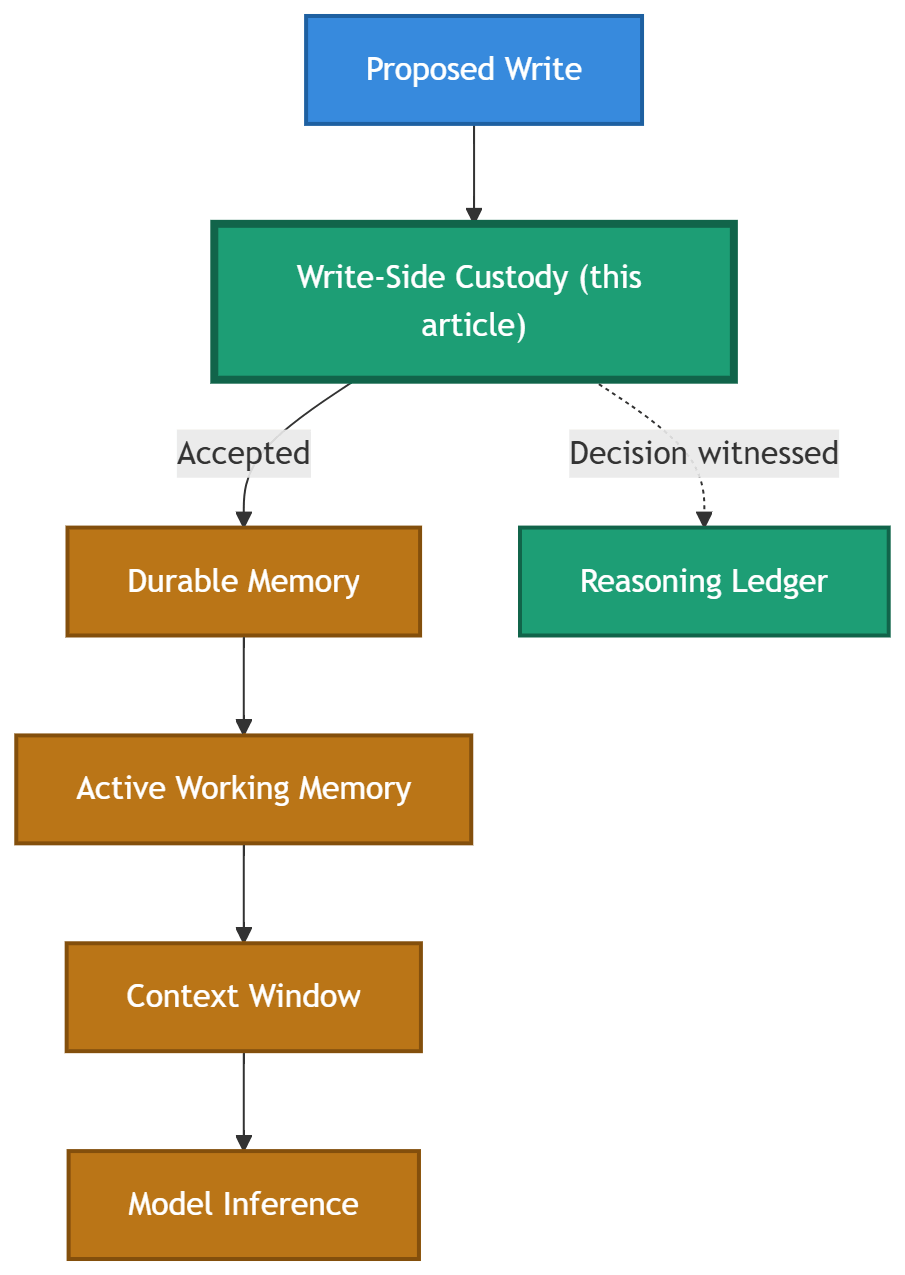
Throughout this series we have gradually separated the responsibilities of an AI system. The Context Window enables execution. Active Working Memory assembles context. Durable Memory preserves knowledge. The Reasoning Ledger explains and records decisions.
None of those layers decides whether a given piece of information deserved to enter the system at all. Knowing what happened is valuable. Ensuring that only trustworthy information became part of what the system knows is what makes the rest of it worth trusting.
The Landfill Problem
Organizations rarely fail because they cannot remember enough. They struggle because they cannot distinguish trusted institutional knowledge from accumulated noise.
This is the failure mode that should motivate everything else in this article. A durable memory that accepts every write eventually becomes a landfill: technically complete, searchable, and useless, because the trustworthy records and the junk are indistinguishable once they are all sitting in the same store with the same retrieval priority. Every low-quality write does not just take up space. It becomes a candidate for future retrieval, future reasoning, and future decisions. A bad write today is bad context tomorrow.
The instinct is to fix this on the read side, with better ranking and filtering. That helps at the margin and loses the war, because by the time a bad record is competing for retrieval, it already looks like everything else. The cheaper and more durable fix is not to accept it in the first place. That decision has to happen at the boundary, before the write becomes memory.
Trust Begins Before Storage
A common architectural assumption is that integrity can be added later. Encrypt the database, protect the backups, restrict access. Those are all worthwhile, and they are also too late. By the time information reaches storage, the most important decision has already been made: whether this write should have been accepted at all.
The Sovereign Systems Specification calls the responsibility for that decision Write-Side Custody. It sits before information becomes durable memory, and it asks a different question than a storage layer does. A storage layer asks whether this can be persisted. Custody asks whether it is legitimate.
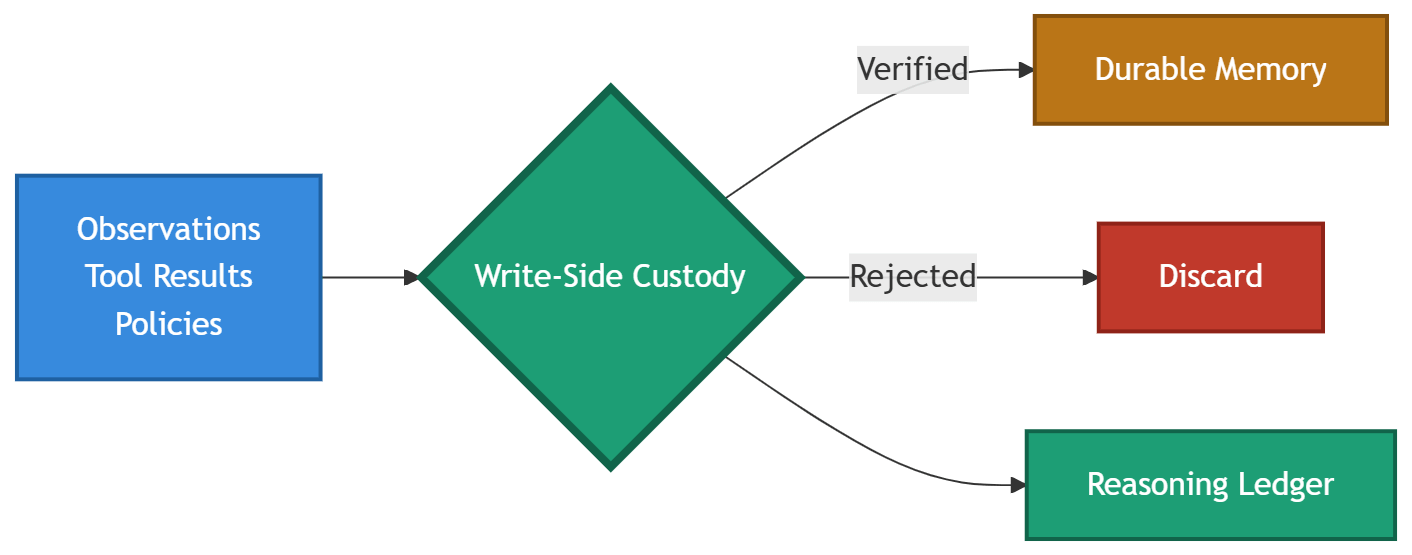
Instead of “can this be stored,” custody asks whether the information is authoritative, whether the source is trusted, whether the supporting evidence was preserved, whether the write violates policy, and whether this should become institutional knowledge at all. The answers determine whether the write is accepted, rejected, or accepted with qualification.
What a Custody Decision Looks Like
Principles are easy to nod along to and hard to picture, so here is a concrete one.
An agent finishes a tool run and tries to write a new record into durable memory:
proposed_write:
  content: "Vendor X is approved for regulated workloads."
  claimed_authority: security-policy
  source: web-fetch:vendor-x-marketing-page
  produced_by: research-agent-run-4471
At the boundary, custody evaluates it rather than storing it:
custody_decision:
  accepted: false
  reason: authority-mismatch
  detail: >
    Record claims security-policy authority, but the source is an
    external marketing page, not the security team's policy service.
    A regulated-workload approval cannot be granted by the artifact
    it would benefit.
  action: discard
  recorded_to_ledger: true
The write never reaches durable memory. The content might even be true, and it still fails, because custody is not judging whether the claim is plausible. It is judging whether this source is allowed to establish that claim as governing knowledge. An approval that arrives from the thing being approved does not get to become institutional memory, no matter how confident the text sounds.
Notice the last field. The rejection did not vanish. It became an event the Reasoning Ledger preserves, which is the point of the next section.
Custody Enforces. The Ledger Witnesses.
There is an apparent contradiction here worth resolving directly, because a reader following the series will feel it.
The Reasoning Ledger, by design, does not enforce. It witnesses. Its records stay examinable precisely because the ledger cannot block anything. Write-Side Custody, by contrast, exists to enforce. It rejects writes. So which is it, do these layers block things or not?
Both, and that is the whole architecture. Custody is the enforcement boundary. The ledger is the witness that records what the boundary decided. When custody rejects the vendor-approval write, custody makes the decision and stops the write, and the ledger records that a write was proposed, evaluated, and rejected, along with the reason. Neither layer does the other’s job. The enforcer never becomes the historian, and the historian never gets a veto. That separation is exactly why each one can be trusted at what it does: an enforcer that also wrote the only account of its own decisions would be unauditable, and a witness that could block actions would stop being a neutral record.
This is the same “separate custody, one interface” principle from earlier in the series, seen from the write side. Different responsibilities, deliberately kept in different layers, cooperating at a boundary.
Every Write Is a Governance Event
Traditional applications treat writes as database operations. Agentic systems should treat them as governance events, because in an agentic system a write is not just data at rest. It is a future participant in reasoning.
Every accepted write influences future retrieval, shapes future reasoning, and becomes a candidate for future decisions. That is a much larger claim than “this row was inserted.” It means the moment of admission is the cheapest and most powerful place to protect everything downstream. A policy check at the boundary is worth more than a great deal of read-side cleverness later, because it prevents the bad record from ever competing for attention in the first place.
Custody is what keeps durable memory intentional rather than merely persistent. It is the mechanism that slows the entropy from trusted knowledge toward landfill, one admission decision at a time.
Looking Ahead
Write-Side Custody decides what is allowed to become memory. It does not, on its own, prove that an accepted record is still byte-for-byte what was written.
Suppose someone asks a harder question six months later: not “should this have been accepted,” which custody answers, but “can you prove this exact record has not been altered since.” That is a different guarantee, and it needs more than an admission policy. It needs evidence that survives independent of the store that holds it.
That is where Forensic Receipts enter the architecture, and where the next article takes us.