The Master Woodworker

(Computer Vision and the Material Memory of Oak)

The harvest is tucked away in the cellar, and the Willamette Valley is settling into its winter rains. In the vineyard, the work has slowed to a crawl. But in the Salvaged Barrel Studio, the tempo is just picking up.

A trailer just arrived with ten “neutral” French Oak barriques. To the winery, these are a liability—bulky, 90-pound puzzles that no longer impart the vanilla and spice notes required for a premium reserve. To them, a $1,200 investment has depreciated to a $50 piece of firewood.

To the Scribe, however, these aren’t waste. They are a library of high-grade white oak staves, each with a material memory we are about to decode.

From Ink to Fiber

In our previous series, we taught the Digital Scribe to recognize 19th-century cursive. We moved from “strings to things” by turning ink into identity. In the workshop, we are performing the same trick, but our ink is wood grain and our strings are geometric dimensions.

To do this, we have initialized a new Master Woodworker Persona. This is an MCP-enabled agent trained in the specific physics of cooperage and furniture design. It understands that a barrel is not a cylinder. It is a collection of parabolic arcs held together by tension. It knows that every stave has a unique “curve” that we must respect if the final chair is going to be comfortable.

The Geometry Capture Layer

The first challenge of salvaged material is unpredictability. No two staves are identical. If I want to build a set of Adirondack chairs, I need a specific count of wide staves (at least 4 inches) for the arms and legs.

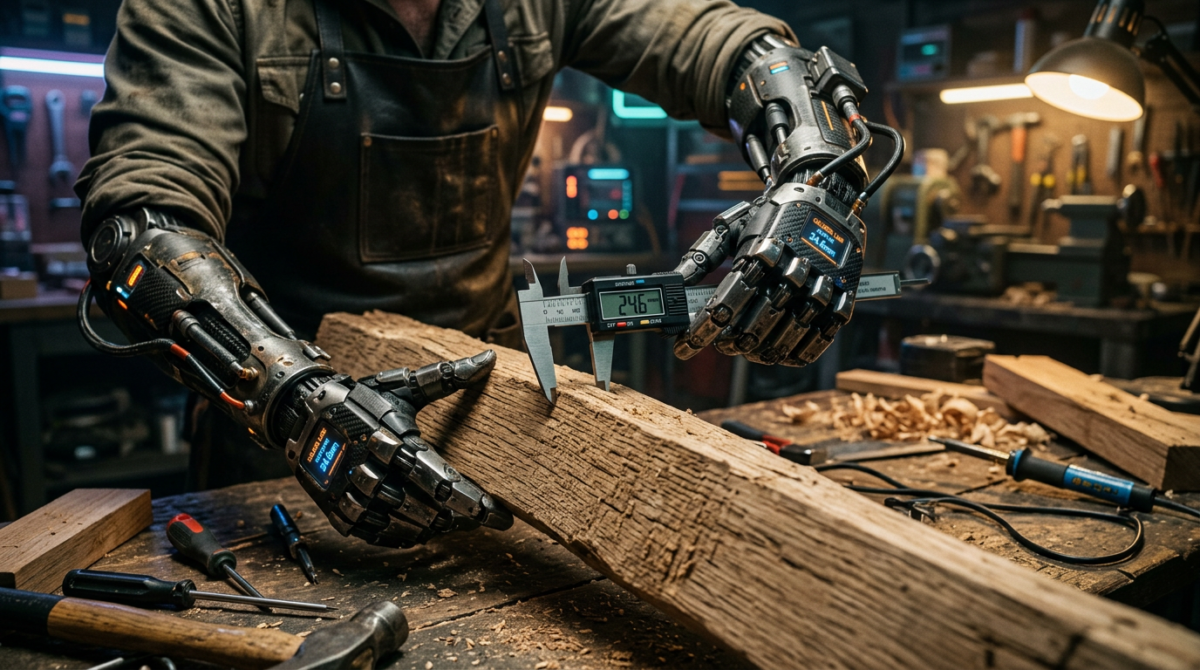
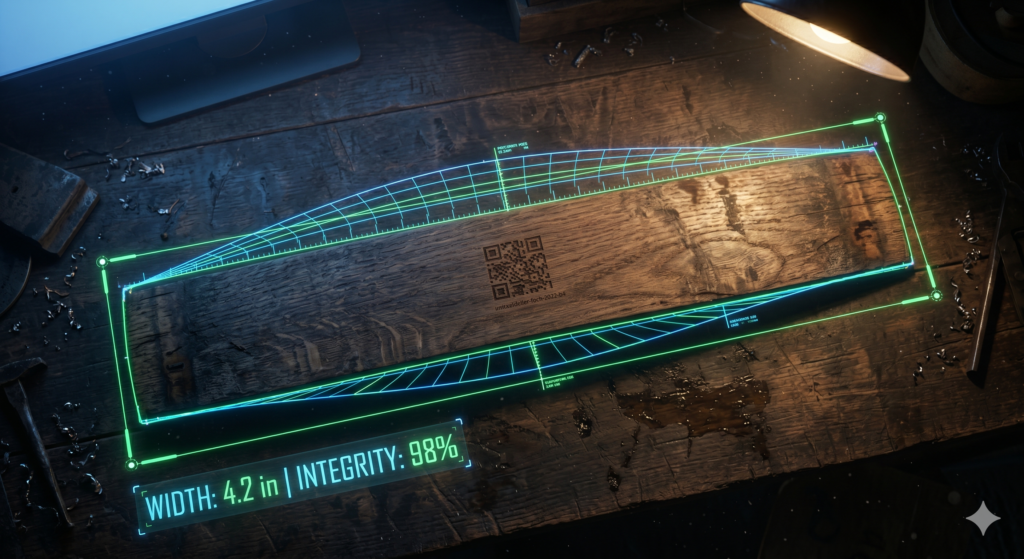
Instead of measuring 300 staves by hand, we use Material-CV which is a computer vision tool that transcribes the wood. By taking a 360° photo of the broken-down barrel, the Scribe performs a geometric audit:

  • Width Mapping: It identifies every stave and categorizes it by its widest point.
  • The Wonky-Check: It flags staves with excessive “twist” or structural defects that would fail under the weight of a seated guest.
  • Wine-Stain Depth: It analyzes the penetration of the wine into the oak fiber, helping us decide which side to showcase for the best aesthetic “pop.”
The Studio Exchange: The Diamond in the Rough

This is where the Sovereign agent earns its keep in the shop. It is not just looking; it is calculating yield.

Maker: “Scribe, I am looking at the stack from the 2022 Reserve barrels. I want to start a run of five side tables. Do we have the material?”

Scribe: “I have analyzed the geometry of those ten barrels. You have a total of 280 staves. However, 40% of those are ‘narrow’ (under 2.5 inches). For the side table tops, you need at least 15 staves with a consistent 3.5-inch width to avoid a ‘busy’ look.”

Maker: “And the structural integrity? These were high-toast barrels.”

Scribe: “The CV scan detected deep heat-checking on 12 of the wide staves. I have flagged those as ‘Incomplete’ for structural use. You have exactly enough premium material for 4 tables, not 5. My recommendation: Pivot the 5th table to a ‘mosaic’ style top using the narrower staves, or wait for the next shipment.”

The Sovereign Maker

This is the “Maker” side of Sovereign AI. It is the ability to run high-level computer vision and material analysis locally, keeping your proprietary designs and inventory private. By using the same architecture that saved a 140-year-old name in a census ledger, we are now saving a 100-year-old oak tree from the burn pile.

We have established the Geometry Capture Layer. We know what we have in the stacks. Next, we will look at Material Provenance and how the Scribe tracks the “Life Story” of each barrel to ensure that the finished furniture carries the same verified history as the wine it once held.

The Master Woodworker Series (Salvaged Barrel Studio)

  • The Master Woodworker (Computer Vision and Material Memory) – This Post

Are you working with salvaged materials or unpredictable inventory? How are you grading your “diamonds in the rough” before you start your build? Reach out on LinkedIn—let’s talk about the intersection of Computer Vision and Craftsmanship.


Facebooktwitterredditlinkedinmail

Active Working Memory: The RAM of Agentic Systems

Part 2 of the Building the AI Memory Stack series

When I published the first article in this series, I thought I was writing about context windows.

The more I wrote, the more I found myself bouncing between documents. I had the glossary open in one browser tab. The Memory as Infrastructure article was open in another. A third tab contained notes about Context Hydration. GitHub was open with the SDK specifications, and a handful of Architecture Decision Records were sitting beside my editor.

None of those documents individually contained “the answer.” Together, they formed the temporary collection of information I needed before I could make progress.

Then something unexpected happened.

I was no longer writing about context windows.

I was reconstructing a memory hierarchy, and the context window was only its first layer.

That is why this became a series.

In Part 1, I argued that the context window is best understood as the CPU cache of an AI system. It is an execution surface, not a memory system. Like CPU cache, it is optimized for fast access and exists only for the duration of the work being performed.

But caches do not populate themselves.

Neither do context windows.

The Working Set Before the Work

Before I could write, I assembled a working set.

Browser tabs and open documents

- Sovereign Systems glossary
- Memory as Infrastructure
- Context Hydration notes
- SDK specifications
- Architecture Decision Records
- GitHub repository
- Article draft

            |
            v

    Active Working Memory

            |
            v

      Context Window

            |
            v

         Reasoning

That collection was not my long-term memory. It was a temporary working set assembled for one task. My brain still had to compare ideas, notice contradictions, and produce something new. The documents simply gave the reasoning process the information it needed.

Agentic systems work in much the same way.

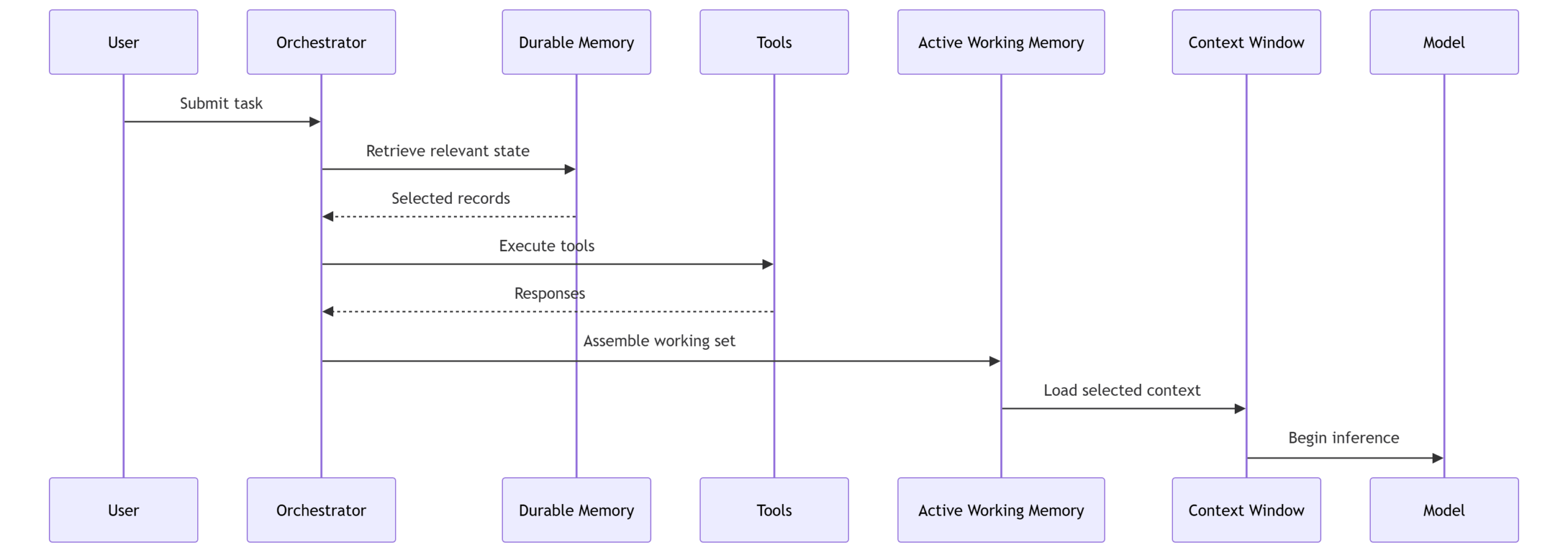
Before a model begins reasoning, documents have been retrieved, tools have executed, state has been restored, policies evaluated, and responses normalized. The prompt is usually the final artifact produced by an orchestration layer, not the beginning of one.

By the time the model receives its first token, dozens of retrieval, filtering, ranking, and assembly decisions may already have been made.

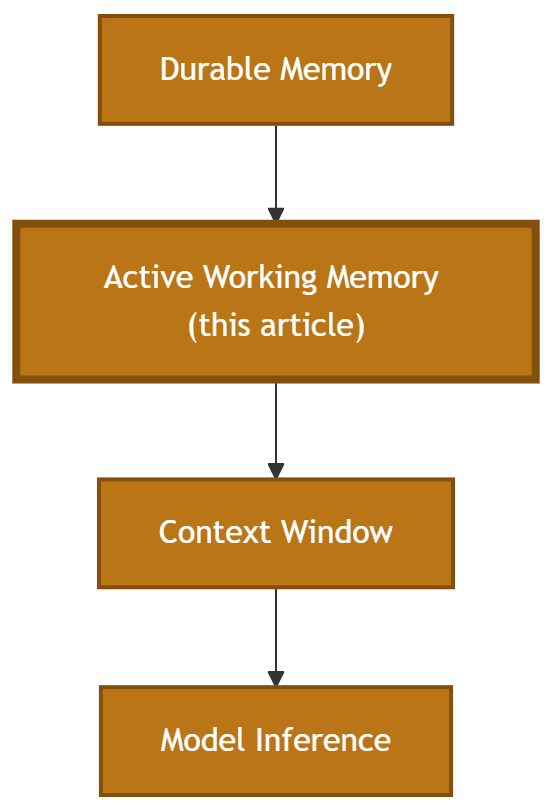
That assembled execution state is what I call Active Working Memory.

Active Working Memory Diagram

This article is about the second layer in that stack.

Models Reason. Applications Assemble.

One sentence captures the distinction this entire article is trying to make.

Models reason. Applications assemble.

Those are different responsibilities.

A model does not retrieve documents.

A model does not decide which Git commit matters.

A model does not know whether a tool response is stale.

An application does.

Consider a concrete case. An agent is asked to update a Python SDK.

It retrieves the ADR describing the package boundary.

It loads the glossary definition of Active Working Memory.

It checks the current implementation on GitHub.

Only then does it build the prompt.

People often talk about “putting something into the context window.”

That wording quietly suggests the context window is responsible for finding, selecting, and organizing information.

It isn’t.

By the time inference begins, the application has already decided what the model will, and will not, be allowed to see.

Working Memory Sequence Diagram

The context window does not begin the process. It receives the result of the process.

Many failures blamed on the model are actually failures of context assembly. The wrong evidence was retrieved. A stale document won. A constraint never made it into the working set. Those are architecture problems before they are model problems.

RAM for Agentic Systems

If the context window is the CPU cache, Active Working Memory is the system RAM.

Layer Primary Responsibility Typical Owner
Durable Memory Preserve knowledge Storage / Application
Active Working Memory Assemble task state Orchestrator
Context Window Present selected information Runtime
Model Perform inference LLM

Each layer has a distinct responsibility. No layer substitutes for another. A larger context window does not repair poor selection, and a better model cannot reason over evidence it never receives.

Search Finds. Context Assembly Decides.

Search answers one question.

What information exists?

Context assembly answers another.

Given this task, what information belongs together?

Those sound similar. Architecturally, they are completely different.

Active Working Memory presents that second decision to the model.

Two systems can use the same model, the same context window, and the same knowledge store yet produce very different results, because one assembles a concise, relevant working set while the other floods the model with loosely related information.

The model is identical.

The memory architecture is not.

An Architectural Boundary

Once Active Working Memory is treated as a real layer, context assembly stops looking like prompt engineering and starts looking like systems architecture.

Information crosses this boundary only after decisions have been made about relevance, authority, recency, format, and priority.

Every unnecessary document increases Context Tax. Every verbose tool response competes for attention. Every missing source creates a blind spot the model cannot recognize from inside the window.

The context window can only reason over what Active Working Memory hands it.

Looking Ahead

The working set I assembled while writing this article disappeared as soon as the article was finished.

The article remained.

That distinction turns out to matter.

Agentic systems face the same decision. What belongs only in today’s working set? What deserves to become tomorrow’s memory?

That is where Part 3 begins.

Models don’t assemble context. They inherit it.

Working memory is not where knowledge lives. It is where knowledge collaborates.

Facebooktwitterredditlinkedinmail