
Part 3 of the Building the AI Memory Stack series
After finishing Part 2, I noticed something.
The browser tabs I had open while writing it were gone. The temporary notes were gone. The diagrams existed only while I was drafting.
The article remained.
That is the question underneath this entire post. Why did one thing survive when everything else disappeared?
A reader asked a version of it directly:
“If Active Working Memory is assembled for each task, where does all of that information come from?”
Most conversations stop at a simple answer.
“The vector database.”
That answer isn’t wrong.
It’s just incomplete.
A vector database is one implementation of durable memory. It is not the architectural definition of durable memory.
Those are very different ideas.
Durable Memory Is Curated
If Active Working Memory is RAM, Durable Memory is not simply “disk.”
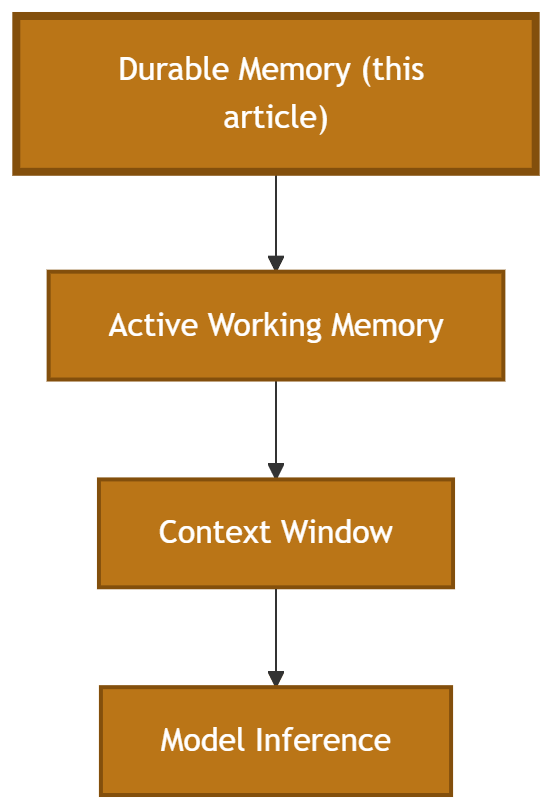
Disk stores everything.
Durable Memory stores what the system intentionally decides to preserve.
Durable Memory is not a place. It’s a policy.
That is a much narrower responsibility.
A durable memory layer may contain:
- Specifications
- User preferences
- Signed evidence
- Architecture Decision Records
- Policies
- Verified observations
- Structured domain knowledge
- Historical interactions
Notice what is missing.
- Scratch calculations
- Intermediate reasoning
- Temporary tool output
- Duplicate information
- Ephemeral context
Those things may have been useful.
That does not mean they deserve to survive.
What Survives Matters
Human memory works the same way.
You don’t remember every sentence you read yesterday.
You remember what became worth remembering.
Agentic systems face exactly the same problem.
Not everything that passes through inference deserves to become memory.
Consider the kind of task from the last article: an agent maintaining an SDK. In a single pass it might retrieve several Architecture Decision Records, read a dozen Git commits, inspect a couple of open issues, call three tools, and generate intermediate summaries along the way.
When the task finishes, should all of that become memory?
Of course not.
Durable Memory is not everything the system observed. It is what the system intentionally decided was worth preserving.
Memory Is a Write Problem
One pattern I’ve noticed across many AI systems is that enormous effort goes into retrieval.
Teams debate embedding strategies, chunk sizes, hybrid search, semantic similarity, and re-ranking pipelines.
Yet comparatively little attention is paid to the opposite question.
Should this be remembered at all?
That is fundamentally a write-side decision.
Traditional software engineers already make this decision every day. We don’t check temporary variables into Git. We don’t commit compiler output. We don’t version our cache directories. We deliberately preserve the artifacts that represent knowledge and discard the ones that existed only to complete today’s work.
Durable Memory asks an agentic system to make the same distinction.
Every stored artifact becomes future context.
Every stored artifact has a maintenance cost.
Every stored artifact competes for future retrieval.
Every write is a promise to your future retrieval system.
Memory is not free simply because storage is inexpensive.
A system that remembers everything eventually remembers nothing particularly well.
The specification has a name for that failure state: the Digital Attic, where everything is kept and nothing can be found.
And when a Digital Attic gets queried, it hands your application a poisoned working set—a mix of current requirements, obsolete notes, and conflicting observations.
When that un-sieved context hits the context window, the system falls into Agentic Thrashing: spending precious inference cycles attempting to reconcile contradictory history rather than making forward progress.
The Difference Between Storage and Memory
This is why I think storage and memory should be treated as separate architectural concepts.
Storage answers:
Can we keep this?
Memory answers:
Should we keep this?
Those are different questions.
A filesystem stores.
A database stores.
An object store stores.
Durable Memory decides.
The Write Boundary
In traditional software architecture we spend a great deal of time discussing APIs.
In agentic systems, I increasingly think the more important boundary is the write boundary, what the specification calls Write-Side Custody.
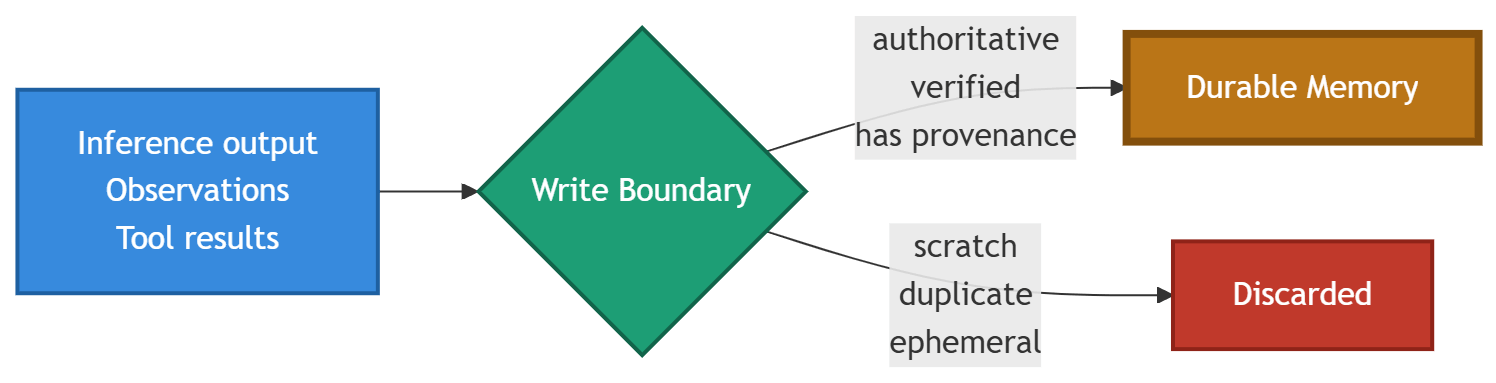
Every piece of information attempting to cross into Durable Memory should answer questions such as:
- Is this authoritative?
- Is it verified?
- Does it duplicate existing knowledge?
- Does it expire?
- Can its provenance be established?
- Is it useful outside the current task?
Those questions determine whether something becomes memory or remains temporary context.
This Is Where Provenance Begins
This is also the point where the Sovereign Systems Specification begins to diverge from many AI architectures.
A memory that cannot explain why it exists is difficult to trust.
If an observation enters Durable Memory, the system should be able to answer:
- Who created it?
- When?
- Under what authority?
- Based on what evidence?
- Has it changed?
- Can it be verified?
Without those answers, Durable Memory slowly becomes institutional folklore rather than institutional knowledge.
Information without provenance is just gossip.
Durable Memory Is an Architectural Responsibility
Just as the previous article argued that Active Working Memory is more than prompt construction, Durable Memory is more than persistent storage.
It is memory as infrastructure: the architectural responsibility for deciding what knowledge deserves to outlive the task that created it.
That responsibility shapes every article that follows.
Deciding what deserves to survive is only the beginning.
The next question is whether the path that produced that knowledge can itself be examined.
That is where Part 4 begins.