
From Cloud to Core: Taking the Forensic Team to Production with Oracle 26ai
Over the last three posts, we’ve done the hard work. We designed a “Zero-Glue” architecture, orchestrated a polyglot multi-agent team, and proved it can run offline on a laptop.
But for a global enterprise, “it works on my machine” is where the trouble begins.
How do you ensure that a thousand agents, running a million audits against critical archival data, all adhere to the same security, privacy, and auditability standards?
Today, we meet the “Final Boss” of AI systems: Governance. We are taking our specialized forensic lab and moving it from a flexible Notion sandbox to the mission-critical, AI-native world of Oracle 26ai.
In 2026, the industry has moved toward HTAP+V (Hybrid Transactional/Analytical Processing + Vector). While Oracle 26ai is a leader in this “all-in-one” approach, many developers prefer a “best-of-breed” or open-source stack.
Governance Engine
To bridge the gap between a laptop demo and a global enterprise, we must move governance out of our Python scripts and into the data layer. In this article, we’ll look at Oracle 26ai as a primary example of an AI-native database, but the principles of the ‘AI Mesh’ apply whether you are implementing this with:
- PostgreSQL + pg_vector + pgai (Open Source)
- Supabase + Edge Functions (Modern Cloud)
- Snowflake + Cortex (Enterprise Data Cloud)
- MongoDB Atlas + Microsoft Foundry (NoSQL/Vector Hybrid)
The Enterprise Gap
In a production environment, you can’t rely on prompt-based guardrails or local JSON logs. Enterprise AI requires infrastructure-level guarantees. Our “Forensic Clean-Room” concept must scale from one laptop to a global, distributed network.
To bridge this gap, we must rethink three core architectural pillars:
Shift 1: The AI-Native Database (Oracle 26ai)
In our demo, we used a simple Notion API. In production, we need a unified knowledge base that treats agents as “first-class citizens.”
Oracle 26ai Select AI Agents allows the database itself to host and govern MCP servers.
Instead of your Python orchestrator managing every single database call (which creates a new MXN integration point!), the orchestrator calls a single Unified AI Agent within Oracle. The database then securely manages the data access, vector similarity search, and even execution of in-database ML models.
Shift 2: Immutable Audits & Row-Level Security
Enterprise systems require strict, verifiable compliance. We must move beyond “trust” and enforce security at the data layer.
Virtual Private Database (VPD) & Row-Level Security (RLS)
You don’t have to “prompt” the AI to ignore certain restricted records. If a junior auditor runs your Python script, the database physically hides the rows they aren’t authorized to see. The agent literally cannot see or hallucinate restricted data.
Blockchain Tables for Audits
Every decision made by the Librarian or the Analyst must be defensible. In 26ai, we can write the “handshake” between agents directly into a Blockchain Table. This creates an immutable, cryptographically signed record of exactly what data the agent saw and what reasoning it produced—a perfect, verifiable audit trail.
The Ultimate Vision: The Enterprise AI Mesh
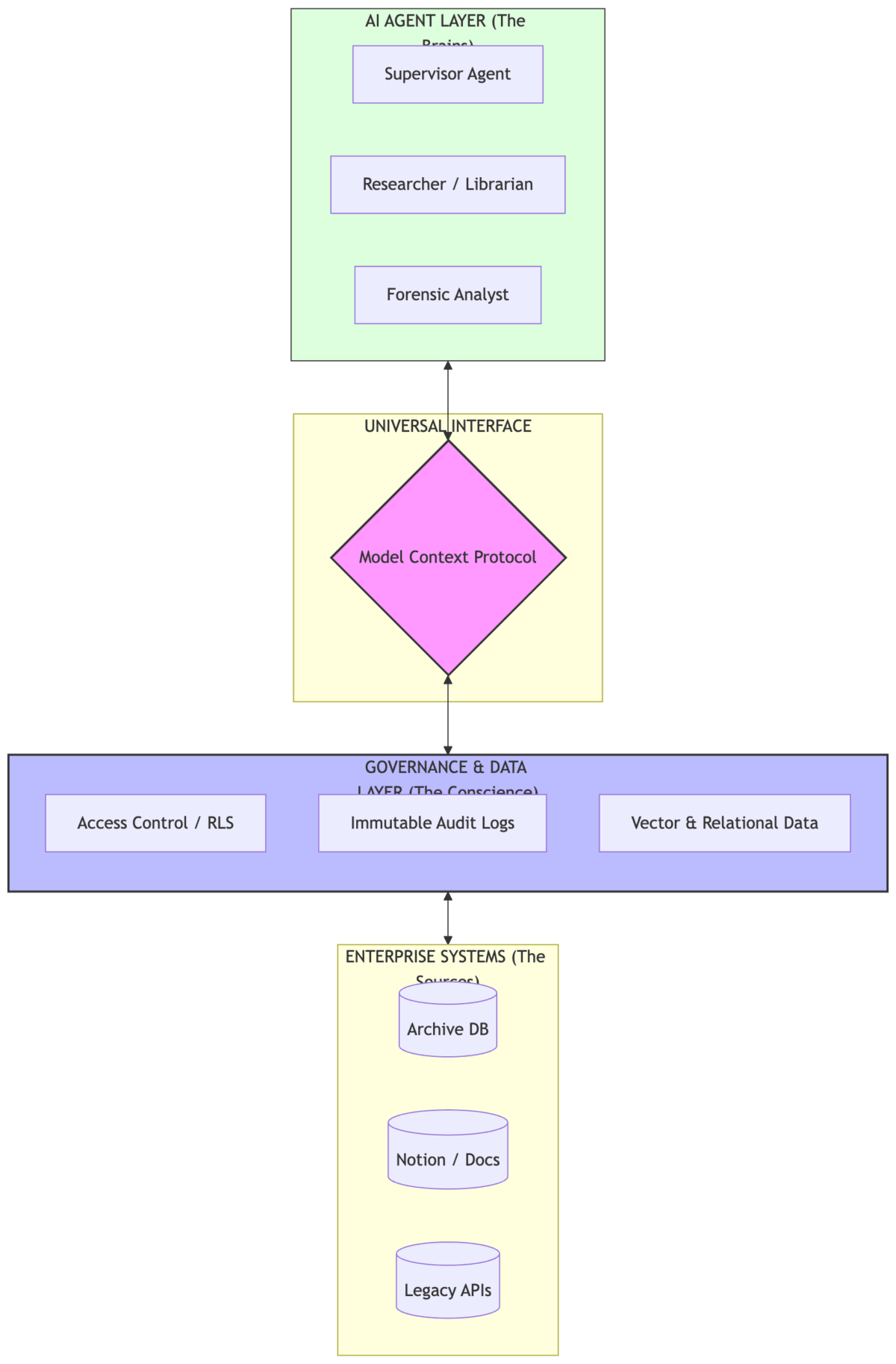
When you move to an enterprise architecture powered by Oracle 26ai, your view of the AI stack fundamentally changes. MCP is no longer just a tool—it is the universal interface of the AI Mesh.
Figure 1: The Enterprise AI Mesh: specialized agents (Clients) connect to standardized, secured MCP Servers. The AI-Native Database acts as the governance layer and unified ‘Source of Truth,’ decouples tools from logic and enabling scalable machine-to-machine autonomy.
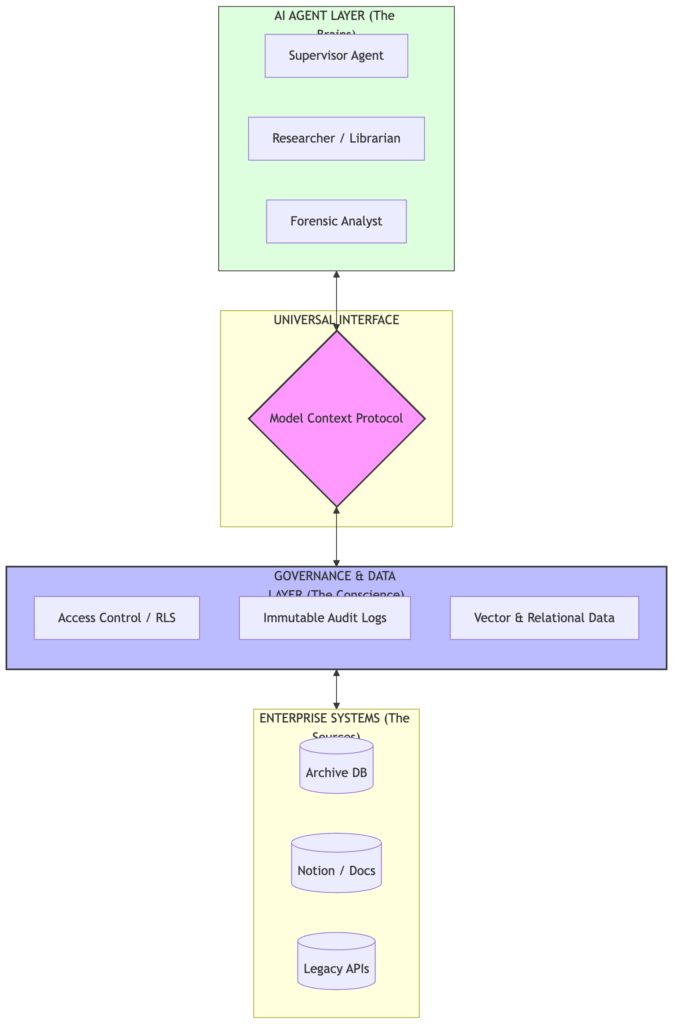
This diagram represents the maturity of your AI system.
- The Clients (Agents): Focus purely on specialized reasoning.
- The Interface (MCP): Provides a standardized, semantic way to discover capabilities.
- The Governance (Database): Enforces security, privacy, and persistence for the entire mesh.
The “End of Glue Code” Is Just the Beginning
We’ve come full circle. The “Zero-Glue” architecture isn’t about deleting code; it’s about architecting systems where the logic and the capabilities are separated by a robust, standard protocol.
Whether you are building a small forensic auditor on your laptop or a global archival intelligence network, the principles of the Model Context Protocol remain the same.
Stop writing the glue. Start building the mesh.
The “Zero-Glue” Series
- Post 1: The End of Glue Code: Why MCP is the USB-C Moment for AI
- Post 2: The Forensic Team: Architecting Multi-Agent Handoffs
- Post 3: From Cloud to Laptop: Running MCP Agents with SLMs
- Post 4: Enterprise Governance: Scaling MCP with Oracle 26ai — You are here