
The Auditor — High-Reasoning Synthesis and the Ethics of Governance

In the last couple of posts, we gave our system Eyes (Local Vision) and a Shield (The Redactor). But a list of findings is not an audit. To provide true value, a forensic system must synthesize disparate data points into a definitive Verdict.

Today, we introduce the final architectural layer: The Auditor and a new, hardened Guardian.

The Auditor: Moving from “Assistant” to “Expert”

Most AI implementations treat the LLM as a general-purpose assistant. In the Sovereign Vault, we use Persona Injection to transform the model into a Senior Forensic Bibliographer.

The Auditor’s job is Synthesis. It cross-references:
The Librarian’s Ground Truth: Archival metadata from our Master Bibliography.
The Eye’s Perception: Local visual findings, including handwritten inscriptions.
The System’s Thresholds: Programmatic rules that define what constitutes a “Match” or a “Forgery.”

The Guardian Pattern: The Human-in-the-Loop

One of the greatest risks in Enterprise AI is Autonomous Overreach. We cannot allow an AI to autonomously finalize a $50,000 transaction. To solve this, we implemented the Guardian Pattern—a mandatory governance gate.

When the system detects a HIGH-severity discrepancy, it triggers a hardware-level pause:

🔴 HIGH SEVERITY FINDING: [High] points_of_issue: expected 'lowercase "j"...' vs observed 'pencil inscription'
Authorize this finding to finalize report? (y/n):

This ensures that while the AI does the heavy lifting of perception and synthesis, the Human Auditor remains the ultimate authority.

Proving Accuracy: The Judge

We move beyond ‘vibe-checking’ our Auditor by implementing the LLM-as-a-Judge framework.

Every architectural change is audited against a Golden Dataset—a ground-truth set of forensic cases—to ensure that our “hardened” logic actually increases accuracy without introducing regression.

The Final Verdict: Circuit-Breaker Logic

To ensure 100% reliability, the “Code” and the “Brain” must agree on the verdict. We implemented Deterministic Circuit-Breakers in our report generator. Even if the AI is “confident,” the code enforces a hard fail if critical indicators are missing:Python# The Auditor’s Programmatic Circuit-Breaker

if num_high > 0:
    verdict = "Authentication not supported — HIGH-severity discrepancies indicate forgery risk."
    confidence = min(confidence, 40) # Force a penalty for risks

Final System Architecture

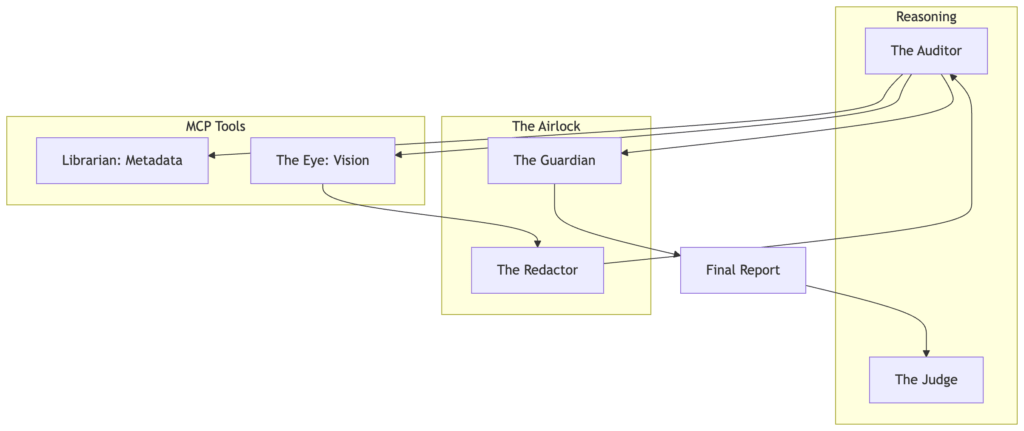
Architectural diagram of the Sovereign Auditor synthesis layer. It shows data flowing from the Librarian (archival data) and The Eye (local vision) into a Reasoning Engine, which then passes through a Guardian HITL gate before generating a final report.
The “Zero-Glue” Synthesis: The Auditor acts as the central nervous system, merging local perception with archival ground-truth while governed by the Guardian handshake.

The Shield is up. The Verdict is in.

We have successfully built the Sovereign Vault. By combining local perception, edge security, and high-reasoning synthesis, we have moved from “prompt-engineered assistants” to a governed Expert System

But beyond the code, what does this mean for the industry? In our next post before we wrap things up, we look at the “Big Picture”: Why the Model Context Protocol is the strategic “USB-C” for the next decade of Enterprise AI.

Coming Next: The Sovereign Vault: Why MCP is the USB-C for Enterprise AI.

Facebooktwitterredditlinkedinmail

The Final Boss: Enterprise Governance & Scalability

From Cloud to Core: Taking the Forensic Team to Production with Oracle 26ai

Over the last three posts, we’ve done the hard work. We designed a “Zero-Glue” architecture, orchestrated a polyglot multi-agent team, and proved it can run offline on a laptop.

But for a global enterprise, “it works on my machine” is where the trouble begins.

How do you ensure that a thousand agents, running a million audits against critical archival data, all adhere to the same security, privacy, and auditability standards?

Today, we meet the “Final Boss” of AI systems: Governance. We are taking our specialized forensic lab and moving it from a flexible Notion sandbox to the mission-critical, AI-native world of Oracle 26ai.

In 2026, the industry has moved toward HTAP+V (Hybrid Transactional/Analytical Processing + Vector). While Oracle 26ai is a leader in this “all-in-one” approach, many developers prefer a “best-of-breed” or open-source stack.

Governance Engine

To bridge the gap between a laptop demo and a global enterprise, we must move governance out of our Python scripts and into the data layer. In this article, we’ll look at Oracle 26ai as a primary example of an AI-native database, but the principles of the ‘AI Mesh’ apply whether you are implementing this with:

  • PostgreSQL + pg_vector + pgai (Open Source)
  • Supabase + Edge Functions (Modern Cloud)
  • Snowflake + Cortex (Enterprise Data Cloud)
  • MongoDB Atlas + Microsoft Foundry (NoSQL/Vector Hybrid)

The Enterprise Gap

In a production environment, you can’t rely on prompt-based guardrails or local JSON logs. Enterprise AI requires infrastructure-level guarantees. Our “Forensic Clean-Room” concept must scale from one laptop to a global, distributed network.

To bridge this gap, we must rethink three core architectural pillars:

Shift 1: The AI-Native Database (Oracle 26ai)

In our demo, we used a simple Notion API. In production, we need a unified knowledge base that treats agents as “first-class citizens.”

Oracle 26ai Select AI Agents allows the database itself to host and govern MCP servers.

Instead of your Python orchestrator managing every single database call (which creates a new MXN integration point!), the orchestrator calls a single Unified AI Agent within Oracle. The database then securely manages the data access, vector similarity search, and even execution of in-database ML models.

Shift 2: Immutable Audits & Row-Level Security

Enterprise systems require strict, verifiable compliance. We must move beyond “trust” and enforce security at the data layer.

Virtual Private Database (VPD) & Row-Level Security (RLS)
You don’t have to “prompt” the AI to ignore certain restricted records. If a junior auditor runs your Python script, the database physically hides the rows they aren’t authorized to see. The agent literally cannot see or hallucinate restricted data.

Blockchain Tables for Audits
Every decision made by the Librarian or the Analyst must be defensible. In 26ai, we can write the “handshake” between agents directly into a Blockchain Table. This creates an immutable, cryptographically signed record of exactly what data the agent saw and what reasoning it produced—a perfect, verifiable audit trail.

The Ultimate Vision: The Enterprise AI Mesh
When you move to an enterprise architecture powered by Oracle 26ai, your view of the AI stack fundamentally changes. MCP is no longer just a tool—it is the universal interface of the AI Mesh.

Figure 1: The Enterprise AI Mesh: specialized agents (Clients) connect to standardized, secured MCP Servers. The AI-Native Database acts as the governance layer and unified ‘Source of Truth,’ decouples tools from logic and enabling scalable machine-to-machine autonomy.

A structural diagram of an Enterprise AI Mesh architecture. At the top, specialized Python agents (Supervisor, Librarian, Analyst) connect via the Model Context Protocol (MCP) to a centralized Governance and Data Layer. The middle layer (Oracle 26ai) manages Access Control, Row-Level Security, and Immutable Blockchain Audit Logs. The bottom layer shows secure connections to enterprise data sources including Archive Databases and internal Notion records.
The Enterprise AI Mesh: specialized agents (Clients) connect to standardized, secured MCP Servers. The AI-Native Database acts as the governance layer and unified ‘Source of Truth,’ decouples tools from logic and enabling scalable machine-to-machine autonomy.


This diagram represents the maturity of your AI system.

  • The Clients (Agents): Focus purely on specialized reasoning.
  • The Interface (MCP): Provides a standardized, semantic way to discover capabilities.
  • The Governance (Database): Enforces security, privacy, and persistence for the entire mesh.

The “End of Glue Code” Is Just the Beginning

We’ve come full circle. The “Zero-Glue” architecture isn’t about deleting code; it’s about architecting systems where the logic and the capabilities are separated by a robust, standard protocol.

Whether you are building a small forensic auditor on your laptop or a global archival intelligence network, the principles of the Model Context Protocol remain the same.

Stop writing the glue. Start building the mesh.

The “Zero-Glue” Series

Facebooktwitterredditlinkedinmail