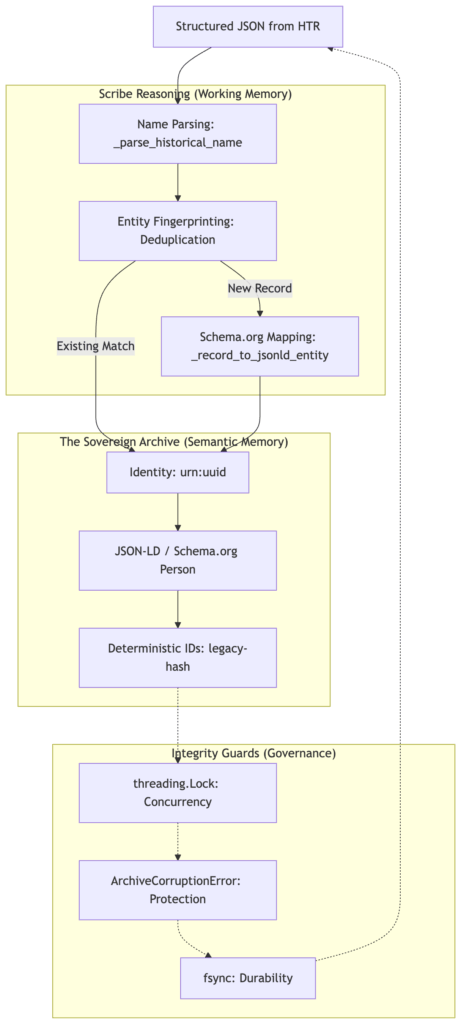
Sovereign Synapse: The Local Brain — First Light

The Local Brain — First Light

A vault of 3,150 Markdown files is just a very organized digital attic. It’s a repository of every conversation, code snippet, and research rabbit hole I’ve navigated with AI over the last two years, but until now, it was static. It was “organized,” but it wasn’t intelligent. To find a specific Movesense API call or a forgotten patent date, I still had to know which box I put it in.

Today, we turn the key. We are moving from mere storage to a private, semantic intelligence estate.

The Engineering Leh Sigh

I call the struggle to reach this point the Leh sigh, that weary, familiar breath you take when a “simple” task reveals its hidden fangs. On paper, building a local semantic search is easy: pick a database, call an embedding API, and save. In reality, it was a 33-iteration battle against the “Last 10%” of systems engineering.

We hit the Context Wall, where massive technical logs crashed the safety limits of our embedding models, forcing us to rethink how we slice data. We fought Zombie Indices, where stale data from old file versions haunted search results, leading us to implement atomic “Delete-before-Upsert” indexing. And we survived a Telemetry Crisis where the database engine tried so hard to “phone home” to its developers that it repeatedly crashed the CLI, requiring a surgical strike to silence the internal trackers.

The Coordinate Map of Thought

To solve these, we built a stack that prioritizes integrity over ease. The centerpiece is Ollama, running the mxbai-embed-large model locally. This is the engine that translates human thought into high-dimensional coordinates.

To ensure no idea was ever cut in half by the model’s token limits, we implemented a sliding window for our data. Before a single vector is saved, the Scribe slices the text into 800-character segments with a 150-character semantic overlap.

def _chunk_text(text: str) -> list[str]:
    """Split text into chunks of CHUNK_SIZE chars with CHUNK_OVERLAP."""
    if not text.strip():
        return []
    if len(text) <= CHUNK_SIZE:
        return [text]
    chunks: list[str] = []
    start = 0
    step = max(1, CHUNK_SIZE - CHUNK_OVERLAP)
    while start < len(text):
        chunk = text[start : start + CHUNK_SIZE]
        if chunk.strip():
            chunks.append(chunk)
        start += step
    return chunks

When a synapse is indexed, we now compute a truncated 16-character SHA-256 content fingerprint hash to serve as our lightweight data-drift indicator. The Scribe is self-aware; if a file hasn’t changed, the system doesn’t waste a single CPU cycle re-processing it. If it has changed, we trigger an atomic update: the old “memories” are wiped, and the new ones are written only if the entire process succeeds. It is all or nothing.

A detailed technical block diagram illustrating the local vector storage indexing pipeline of the Sovereign Synapse system. The workflow reads a Markdown file, extracts YAML frontmatter, and strips conversational prose tax. The remaining body content passes through a content-hash check: if the 16-character SHA-256 fingerprint matches an existing entry, the index process skips it to avoid duplicates. Unmatched data proceeds to a sliding-window text chunker (800-character blocks with 150-character overlaps). Each chunk hits an Ollama embedding loop; if it triggers a status 400 error due to dense logs, a fallback loop applies a hard 500-character truncation before retrying. Once all embeddings succeed, an atomic 'delete-before-upsert' transaction executes, safely removing the collection's old UUID records before bulk writing the new vector batch into local ChromaDB storage.

The Payoff: Semantic Spotlight

The result is what I call “First Light”—the moment the machine actually understands the intent of a query. By searching across what has now become 12,400 semantic chunks, the Scribe pulls the needle from the haystack in under three seconds.

# Querying two years of research in 2_The_Prose_Tax.8_Forensic_Receipt seconds
python3 main.py query "Movesense calibration" --n-results 1

🔍 Top 1 match for: Movesense calibration

--- Result 1 ---
Timestamp: 2025-06-20 07:07
Snippet: It sounds like rolling my own would indeed be the best option, plus if I'm working 
         directly with therapists they might have some insights into what specific 
         information would be valuable for their clients...
File: vault/synapses/2025-06-20-0707-rolling-my-own-logic.md

This isn’t keyword matching. The system found this result because it understood the concept of building a custom calibration tool for clinical use, even though the word “calibration” only appeared in the broader file context.

The Sovereign Architecture

As the vault grows, the relationship between my data and my hardware becomes the ultimate bottleneck. By running embeddings on-device, my queries never leave the local network.

Privacy isn’t a setting; it’s the architecture.

Storing the index on a high-performance NVMe ensures that the “latency of thought” remains sub-second, even as the estate expands. The foundation is set: 3,150 synapses, 12,400 semantic vectors, and not a single byte sent to the cloud.

We have moved from a digital attic to a living cognitive estate, where the value of the data isn’t just in its existence, but in its accessibility.

But a brain that only remembers the past is just a library. To truly act as a collaborator, the Scribe needs to do more than find information—it needs to synthesize it. In Phase 2, we stop looking backward and start building the future. It’s time to let the Scribe talk back.

How do you handle the “digital attic” problem in your own workflow? Is your data working for you, or are you just storing it?

The Sovereign Synapse Series

Facebooktwitterredditlinkedinmail

The Long Way Around

For most of my professional life, I assumed I had a collection of unrelated careers.

Over the years I worked in politics, professional kitchens, construction, technical education, developer advocacy, and technology leadership. More recently, I’ve found myself spending time on institutional memory, provenance, AI architecture, museums, archives, and historical research.

Looking at that list on paper, it feels random. A career counselor might call it a lack of focus. An Applicant Tracking System would almost certainly struggle to figure out what box to put me in.

For a long time, I viewed it the same way. Every career change felt like starting over. Every transition came with the uncomfortable feeling that everyone else had chosen a lane and stayed in it while I was wandering between industries.

It wasn’t until recently, while working on the Sovereign Systems Specification and updating my personal website, that I began to notice something unexpected.

The industries had changed.

The questions had not.

The Same Questions in Different Places

When I worked in politics, information was everything. Every statement, every policy position, and every talking point ultimately came down to a simple question:

“According to whom?”

When I worked in professional kitchens, the same question appeared in a different form. Recipes, inventory, supplier relationships, food safety procedures, and training all depended on knowledge being documented, shared, and trusted. Making the same “house ranch” recipe from memory isn’t the same as having it written in a procedure.

Construction wasn’t much different. Plans, permits, change orders, inspections, and customer agreements all relied on accurate information and a clear understanding of where that information came from. A builder who’s working from memory instead of the stamped plans builds the wrong room. That’s not a rounding error — that’s a tear-out.

Technology brought the same challenges into a new domain. Documentation, system architecture, databases, APIs, observability, and developer education all revolve around helping people understand complex systems and trust the information they are using to make decisions.

More recently, my interests have expanded into museums, archives, historical research, and AI systems. Yet even there, the same themes continue to emerge.

The questions kept reappearing in different forms:

  • How do people store knowledge?
  • How do they trust knowledge?
  • How do they lose knowledge?
  • How do they pass knowledge to the next generation?

The technology changes. The industries change. The underlying questions remain remarkably consistent.

A Phrase That Refused to Stay in One Project

While writing the Sovereign Systems Specification, I coined a phrase that I initially thought was simply a good line:

Information without provenance is just gossip.

At first, it was intended as a commentary on AI systems. Large Language Models are increasingly capable of producing convincing answers, but confidence is not the same thing as evidence. If an answer cannot be traced back to a source, its reliability becomes difficult to evaluate.

The more I thought about it, however, the more I realized the phrase applied far beyond AI. Every field where trust matters has a provenance problem.

The phrase kept showing up because the principle kept showing up.

Eventually I stopped thinking of it as an AI concept and started viewing it as a general truth.

Maybe It Wasn’t Several Careers

For years I looked at my resume and saw a collection of disconnected experiences.

Politics, culinary arts, construction, technology, education, and research.

The assumption was that these represented different chapters of my life.

What I’m beginning to suspect is that they were all chapters in the same story.

The industries were different. The tools were different. The job titles were different.

What remained constant was an interest in understanding how knowledge is created, organized, trusted, preserved, and shared.

Seen through that lens, the transitions no longer look quite so random.

Politics was about information and trust.

Kitchens were about process and knowledge transfer.

Construction was about documentation and accountability.

Technology was about systems and understanding.

Museums and archives are about preservation.

AI is forcing us to revisit all of those questions at scale.

The Questions That Follow Us

One of the unexpected benefits of getting older is that you eventually accumulate enough experiences to identify patterns that were invisible while you were living through them.

In your twenties and thirties, careers often feel like a sequence of decisions.

In your forties and fifties, they sometimes start to look more like a sequence of questions.

The jobs change.

The industries change.

The technologies change.

The questions worth asking tend to remain remarkably consistent.

Looking back, I don’t think I’ve spent thirty-five years working in a series of unrelated professions.

I think I’ve spent thirty-five years exploring the same problem from different angles.

And perhaps that’s the lesson hidden inside a long and winding career:

The most important thing you carry from one job to the next isn’t a title, a skill, or a technology.

It’s the set of questions you never stop asking.

That’s the foundation the Sovereign Systems work is built on.

<>
That’s the foundation the Sovereign Systems work is built on.Facebooktwitterredditlinkedinmail