Declarations from the Periphery: From Genesis to the Sovereign Edge

In July of 1776, an experimental political concept was ratified on the extreme edge of the known geopolitical world. It was a declaration that governance belongs at the local perimeter, that centralized authorities separated by massive physical latencies are structurally unfit to dictate local operations, and that true autonomy requires independent record-keeping.

As we approach America’s 250th birthday, a remarkably similar battle is playing out across our global computational geography.

For the past decade, the tech industry has willfully surrendered its architectural sovereignty to centralized cloud empires. We have been told that our applications are nothing without an unbroken connection across the ocean to a hyperscaler’s data center. We have been conditioned to accept that if the central cloud goes offline, our peripheral operations must grind to a halt.

The Sovereign Systems Specification was built to break that dependence. And this week, after multiple rounds of attrition against the realities of edge computing, we have officially stabilized and shipped the foundational bridge for off-grid data custody: sovereign-sdk-edge and sovereign-sdk-sensor, alongside a fully unified v1.3.0 workspace release.

Here is the forensic anatomy of how we forged an industrial-grade local data fortress, and why local sovereignty is the only path forward for high-assurance systems.


The Frontier Cannot Rely on the Crown

Every sovereign record must begin somewhere.

The introduction of sovereign-sdk-sensor establishes custody at the Point of Genesis—the precise moment a physical event becomes a digital artifact. Whether the source is a temperature probe, a voltage reading, or a machine-state transition, Sensor seals the event before it crosses a network boundary, enters a queue, or becomes subject to external influence.

Only then does sovereign-sdk-edge assume responsibility for preserving that evidence across unreliable infrastructure.

When you operate hardware on the physical edge—whether it’s a manufacturing floor, an IoT sensor array, or an isolated developer workstation—network connectivity is a luxury, not a guarantee.

If an edge node captures critical telemetry or a signed cryptographic proof, and the primary ledger is unavailable due to an outage, dropping that data is an operational failure. But blindly caching it in volatile memory is equally negligent.

To solve this, sovereign-sdk-edge implements an Asynchronous Off-Grid JSONL Buffer backed by an HMAC-Gated Ingestion Bridge. It ensures that if the centralized ledger goes dark, data is cleanly parsed via strict model version gates, transformed through local telemetry sieves, and written into a durable on-disk journaling file.

But building a local buffer that actually survives the violent physics of the edge is an entirely different beast. To achieve the level of reliability demanded by edge infrastructure, we put the codebase through an exhaustive code review gauntlet.

We didn’t just design for the happy path; we engineered for the catastrophe.


Forensic Anatomy of the Engineering War

To guarantee that no packet is ever dropped, duplicated, or corrupted during a system failure, our architecture had to be hard-coded against low-level disk anomalies and concurrency race windows. Here are the core architectural battles we fought and won:

1. The Two-Phase Commit Teardown Race

During a recovery pass, when the off-grid buffer replays saved logs back to the primary ledger, any entries that fail must be re-queued safely back into the active queue. Early iterations called flush() and immediately deleted the temporary .staging file.

  • The Blast Radius: If the disk filled up or hit an OSError during that exact millisecond, the background worker shunted those records into an in-memory error tracking array. Because the worker “handled” the error, flush() returned successfully, and the system deleted the .staging backup. A power loss a millisecond later permanently vaporized the data.
  • The Sovereign Fix: We hardened commit_drain() to explicitly inspect internal volatile buffer states. If any record shifts to an in-memory error list or a background thread experiences a hiccup during flushing, the commit unlinking path is immediately aborted, preserving the on-disk .staging log for a future clean recovery pass.

2. The Volatile Write-Error Ghost Window

When executing a queue drain when the primary active log file was missing, the recovery thread would read the local .quarantine log, write it to .staging, and yield the items.

  • The Blast Radius: While the on-disk quarantine text was mirrored to disk, the volatile, in-memory _write_errors array entries were returned for processing without ever being physically appended to the .staging cleanup file. A crash window existed where restart recovery would look at an incomplete staging file, orphaned from its volatile state.
  • The Sovereign Fix: We updated the drain() matrix to force full, synchronous serialization of both the on-disk quarantine logs and the volatile in-memory error snapshots into a unified, physical .staging artifact before any transactional logic yields.

3. Overlapping Lifecycle Lock Interleaves

In high-throughput environments, multiple concurrent threads can attempt to trigger a pipeline recovery pass.

  • The Blast Radius: While counter math was protected by an execution lock, the file unlinking mechanisms in commit_drain() were separate from the active file shuffling in drain(). Thread B could execute a clean commit and delete the shared .staging path right as Thread A rotated the active files but before Thread A actually processed the yielded items.
  • The Sovereign Fix: We aligned the execution gates. The entire cleanup lifecycle of commit_drain() is now bound to the exact same high-level operational synchronization lock used by drain(), completely eliminating concurrent file-clearing race windows.

Ratifying the New Union: The sovereign-sdk-* Namespace

As these edge modules matured into industrial infrastructure, our own project layout faced a structural crisis reminiscent of the early American Articles of Confederation. We had a collection of fragmented packages (sovereign-core, sovereign-ledger, sovereign-sieve) operating under loose structural bounds.

To establish a more perfect architectural union, we executed a sweeping namespace migration alongside our edge release.

As of today, all core packages have been unified under the official sovereign-sdk-* distribution space on PyPI, completely locked to a normalized baseline version of 1.3.0.

For our existing production users, we have deployed a seamless migration path. The historical package names (sovereign-core, sovereign-ledger, etc.) have been updated to clean, code-free metadata wrapper envelopes. Running a dependency update on your legacy configuration will automatically and safely forward your package manager to pull down the newly scoped sovereign-sdk-* equivalents without requiring you to rewrite a single internal Python import string.


The Next Boundary

With v1.3.0, the Sovereign SDK now establishes custody at the point of origin, preserves evidence through durable local ledgers, and maintains operation across intermittent network conditions.

But sovereignty is not solely an ingestion problem.

Modern systems spend enormous effort controlling what enters their perimeter while giving comparatively little thought to what leaves it.

Every day, developer tools, autonomous agents, and enterprise applications transmit vast amounts of context across organizational trust boundaries to increasingly capable external systems. Most organizations can tell you where their data is stored. Few can tell you precisely what was transmitted, why it was transmitted, whether it could have been reduced, or what that decision ultimately cost.

The next phase of the Sovereign Systems Specification will focus on this outbound boundary.

Not on blocking innovation.

Not on replacing frontier models.

On understanding the economics, provenance, and governance of data once it prepares to leave a sovereign perimeter.

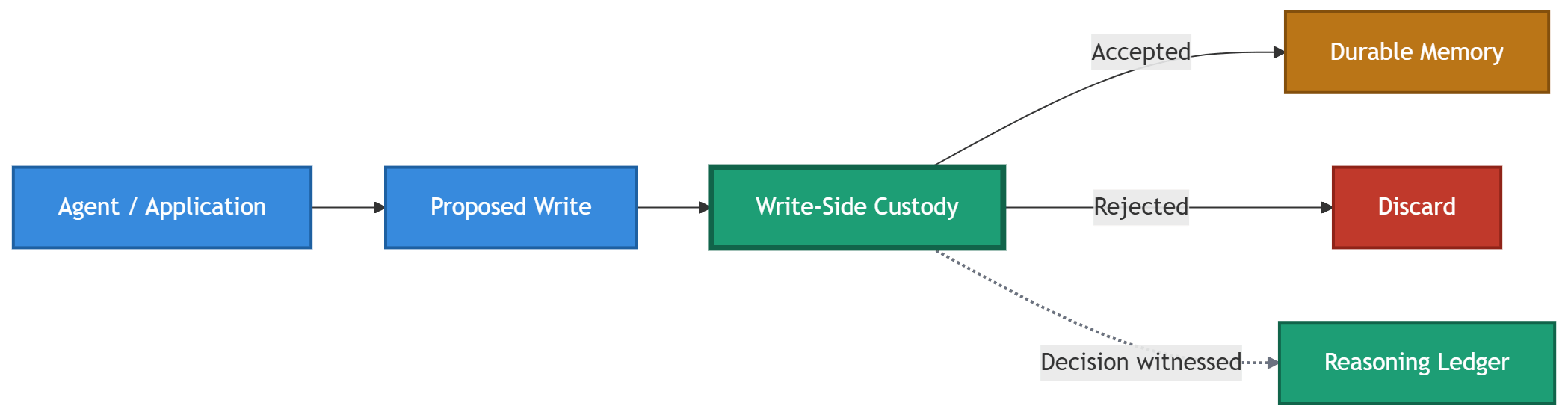
The same questions that shaped write-side custody now apply in reverse:

  • What is leaving?
  • Why is it leaving?
  • How much of it is actually necessary?
  • What evidence should remain behind?

Those questions will guide the next chapter.

The code is live. The architecture is battle-hardened. The declaration has been signed.

Go explore the unified sovereign-sdk v1.3.0 workspace on GitHub, pull down the new edge modules from PyPI, and claim your independence from the crown cloud. 🚀🔒

Facebooktwitterredditlinkedinmail

The New Information Borders

Recently I came across a discussion about AI crawlers and robots.txt files. The conversation centered on a simple question:

Should website owners allow AI systems to access their content?

One proposed configuration looked something like this:

User-agent: ClaudeBot
Allow: /

User-agent: GPTBot
Disallow: /

User-agent: ChatGPT-User
Disallow: /

User-agent: PerplexityBot
Disallow: /

At first glance this is a reasonable policy decision.

Perhaps a company has a commercial relationship with one AI vendor and not another. Perhaps it trusts one organization more than another. Perhaps it simply dislikes a particular company and would rather that company not benefit from its content.

These are all rational decisions. And worth remembering: robots.txt is a request, not a wall. It governs the crawlers that choose to honor it. The borders we are about to talk about form through compliance norms and licensing agreements, not through technical enforcement.

The interesting part is what happens when thousands of organizations make similar decisions at once.

The Web We Assumed

For most of the modern Internet era, there was an implicit assumption that people were operating from a broadly shared information environment.

Search engines differed in quality. Ranking algorithms differed. Some sources were easier to discover than others. But in general, if two people searched for information on a topic, there was a good chance they were drawing from many of the same underlying sources.

The web functioned as a largely shared corpus of knowledge.

That assumption may not hold forever.

Fragmentation Without Malice

When people discuss information fragmentation, they often jump straight to government censorship, national firewalls, or deliberate propaganda systems.

Those are real examples. But fragmentation does not require any malicious intent.

Imagine the following:

  • Company A blocks OpenAI but allows Anthropic.
  • Company B licenses content exclusively to OpenAI.
  • Company C blocks all AI crawlers.
  • Company D optimizes specifically for one AI platform.
  • Company E maintains a private agreement with a commercial search provider.

None of these organizations is trying to create information silos. Each is making what looks like a reasonable local decision.

Collectively, those decisions begin to produce different information environments. The divergence does not emerge from AI reasoning. It emerges from AI access.

None of these organizations is trying to create information silos. They are simply trying to protect their intellectual property or negotiate a survival-level licensing deal in an ecosystem that no longer sends them traffic. Each is making what looks like a reasonable local decision.

Two Kinds of Access

It helps to separate two things that fragment differently.

The first is what a model was trained on. The second is what a model can reach at the moment you ask it a question.

Today these overlap heavily. Most large models are built from many of the same underlying sources: the same crawled archives, the same bulk licensing deals, the same public web that has been scraped for years. At the training layer, the corpus is still mostly shared.

Retrieval is where the divergence is already happening.

When a model answers using live access to the web, the robots.txt rules, the licensing agreements, and the private deals all decide what it is permitted to pull in right then. One system can cite a source. Another is told it may not look. Same question, different evidence, and the difference has nothing to do with how either model reasons.

So the honest version of the claim is not that Claude and ChatGPT already see two different webs. It is narrower and more defensible:

Retrieval access is fragmenting now. Training access could follow.

That second part is the one worth watching. If exclusive licensing becomes the norm rather than the exception, the divergence stops being a retrieval-time quirk and starts being baked into what each model knows at all. The shared corpus we have taken for granted would quietly stop being shared.

The Difference Between Thinking and Seeing

When two AI systems produce different answers, we tend to assume the difference lies in how the models reason.

Sometimes that is true. Increasingly, though, the more important question may be a different one: what information was the model allowed to see?

An answer generated from complete evidence and an answer generated from partial evidence can both arrive with equal confidence. Only one of them may reflect the full record.

The distinction matters.

A model cannot mourn the data it was never allowed to read. It simply synthesizes a flawless, highly confident answer out of the fragment it has, leaving the user entirely unaware of the missing horizon.

Museums Learned This Long Ago

One reason I spend so much time thinking about provenance is that museums, archives, and historians have wrestled with these questions for decades.

Researchers care not only about what artifacts exist. They care about what artifacts are missing. Absence affects interpretation. A collection missing half of its records tells a different story than a complete one, and a careful researcher never mistakes the surviving fragment for the whole.

AI systems face the same challenge. A model can only reason from the evidence available to it. If the evidence becomes fragmented, the resulting interpretations may diverge even when the underlying reasoning processes remain sound.

The Sovereign Systems Perspective

The Sovereign Systems Specification is built around a simple observation:

Information without provenance is just gossip.

Most discussions of provenance focus on where information came from. The harder and more neglected question is what was left out.

Not only:

Where did this information originate?

But also:

What information was unavailable?

What information was excluded?

What information was never allowed into the system at all?

Absence is itself a provenance category. A record of what a system could not see is as much a part of its lineage as a record of what it could. Those questions become more important, not less, as AI systems become primary interfaces to knowledge.

While commercial cloud models hide their data deficits behind a smooth conversational curtain, a Sovereign system must explicitly map its own borders—declaring exactly what lies within its registry, and where the boundary of its knowledge ends.

The New Information Borders

I do not believe AI is creating separate realities. We are.

Not through any coordinated effort. We are simply making thousands of local decisions about access, licensing, trust, governance, and control.

The cumulative effect may be the emergence of informational borders that are far less visible than national borders but no less consequential.

So here is the thing to watch for. The next time two AI systems hand you different answers, do not stop at asking which one reasoned better. Ask what each one was allowed to see. The gap between them may have nothing to do with intelligence and everything to do with access.

The web once assumed a largely shared corpus of knowledge. The next generation of knowledge systems may not.

When two AI systems disagree, are we observing different reasoning? Or are we observing different worlds?

Facebooktwitterredditlinkedinmail