
Rack Before You Remember

What racking wine teaches about agent memory
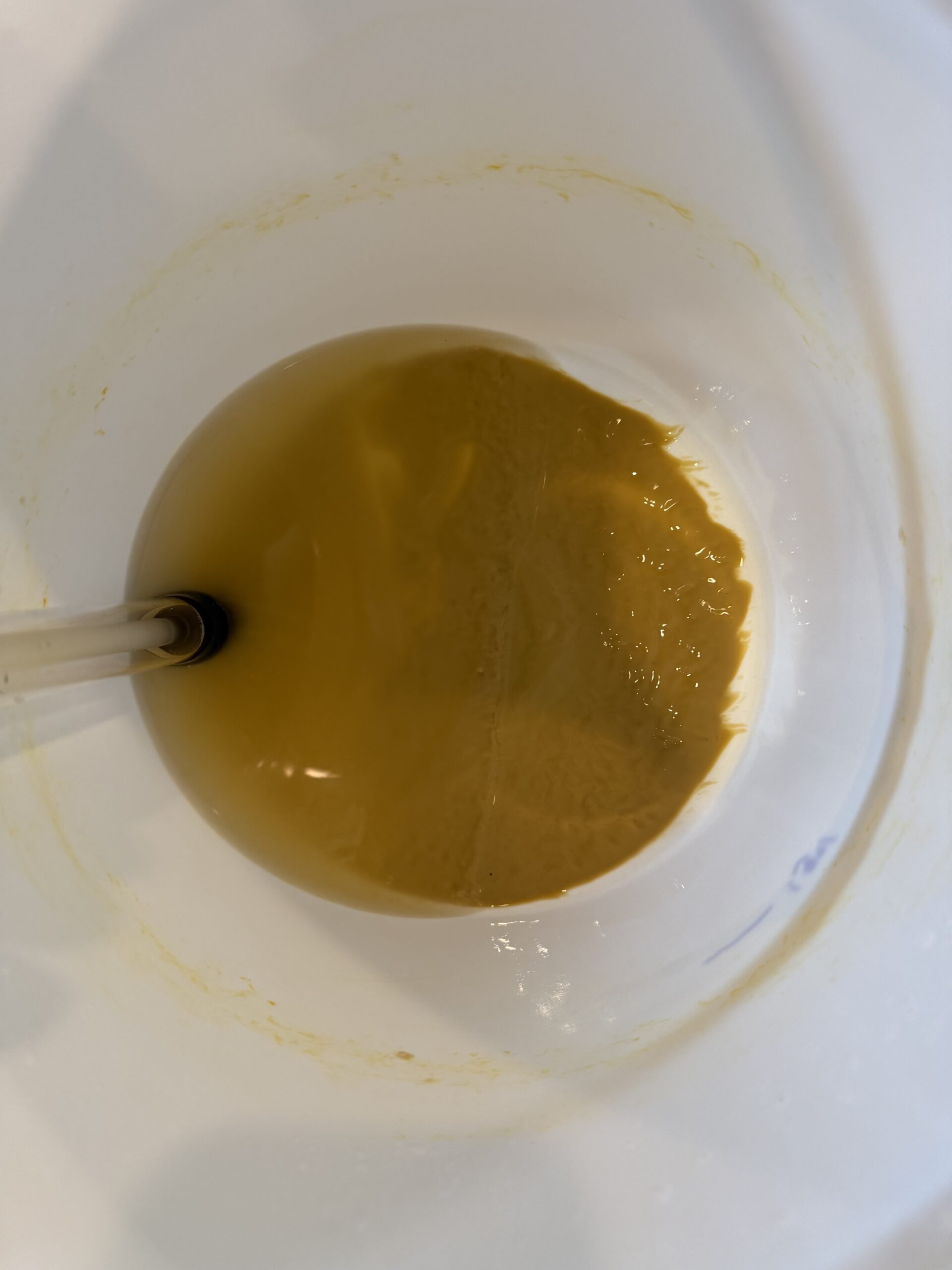
The bottom of a white fermenting bucket seen from above, holding a shallow pool of cloudy golden mead over a thick layer of tan sediment, with the tip of a clear siphon tube resting at the edge of the pool.

The mead’s lees on October 21, with the racking cane at the edge. Everything the siphon left behind stays here.

That layer at the bottom of my mead fermenter did most of the work of turning honey and water into something worth drinking. It’s spent yeast and the debris of a few weeks of vigorous fermentation. Without it, there’d be nothing to rack.

I left all of it behind on purpose.

What lees are, and why they stay behind

When primary fermentation winds down, the yeast that did the work drops out of suspension along with whatever solids came along for the ride. That sediment is called the lees, and the first, heaviest layer is known as the gross lees.

Racking is how you separate the wine from it. You siphon the wine off from above, carefully, into a clean vessel, and leave the sediment where it settled. I racked the pear wine on October 12, once the readings had held steady long enough to justify the move, and the mead on October 21, when its refractometer reading had settled at 3.2 Brix.

The pear racking went smoothly, and it taught me something I didn’t expect. I’d added bentonite, a clay that binds proteins and helps haze drop out, and I assumed that by racking day the wine would be close to see-through. It wasn’t. It’s not murky, but it’s not clear either. Racking had separated the wine from the heavy sediment. It hadn’t made the wine clean. The finer material still in suspension will take weeks to settle, and there will be another racking after it does.

Hold on to that distinction, because it comes back later.

The reason to rack isn’t that the lees are bad. It’s that their job is done. Left in contact with the wine too long, the heavy lees start to break down, and the compounds they release can push the wine toward off flavors that range from dull to genuinely unpleasant. Material that was essential during fermentation becomes a liability during aging.

That’s the whole article in one sentence: not everything useful during execution deserves to survive execution.

Agents have lees too

Watch an AI agent work through a nontrivial task and you’ll see the equivalent of a primary fermentation. It retrieves documents, most of which turn out to be irrelevant. It calls tools and gets back large blobs of output. It tries an approach, hits an error, and backs out. It forms hypotheses that don’t survive. It reads text from untrusted sources, some of which might contain instructions it was never supposed to follow.

All of that is essential while the task is running. The failed attempts are how it found the working one. The irrelevant documents are how it figured out which were relevant.

And then the task ends, and a surprising number of memory designs do the equivalent of never racking the wine. The transcript gets saved. The tool outputs get embedded. The scratchpad gets summarized into long-term memory without anyone deciding which parts of it were conclusions and which were sediment.

For a while, nothing seems wrong. Then the lees start to break down. A hypothesis the agent abandoned on Tuesday gets retrieved on Friday as if it were a fact. An error message from a transient outage becomes a durable belief that some service is broken. A snippet of injected text from a web page resurfaces, weeks later, in a context where it looks like a user preference. None of these were bad things to have during the task. They’re bad things to have in the cellar.

You can’t filter it out at the glass

The obvious objection is that you can sort it out later. Store everything, and let retrieval figure out what’s relevant.

Winemaking has a pretty clear answer to that. If you leave the wine on the gross lees for months, you can’t fix it by pouring carefully. The problem isn’t that sediment ends up in the glass; you could decant that away. The problem is what the sediment did to the wine while it was stored together.

Memory systems work the same way. Raw execution material doesn’t just sit inertly waiting to be filtered at read time. It gets summarized, and the summaries inherit its errors. It gets embedded, and it competes in similarity search with things that were actually true. It feeds derived facts, and those facts get cited by later tasks. By the time a read-side filter sees it, the contamination has already been folded into things that look clean.

None of this means throwing the raw record away. Transcripts and tool outputs are genuinely valuable for debugging, forensics, and compliance, and a system that can’t reconstruct what an agent did is its own kind of problem. The distinction is between keeping evidence and promoting it into memory. A raw execution log in an archive the agent never retrieves from is evidence. The same log embedded into the store the agent reasons from is sediment in the wine. Winemakers make the same split: lees you want to keep go into a separate jar, for cooking or for starting the next batch. They don’t stay in the carboy.

That’s why I’ve come to think the decision about what persists belongs at write time, as a deliberate boundary, rather than being deferred to whatever happens to read the store later. I’ve been calling this Write-Side Custody: the system that writes memory is responsible for what it lets in, and for being able to say why.

One boundary doesn’t make it clean

Remember the hazy pear. A write-time boundary works the same way the first racking does: it removes the gross sediment, the material that’s obviously done its job and is obviously going to cause trouble. It doesn’t guarantee that what passes through is perfectly clean.

Some fine material always comes along. A conclusion that seemed confirmed turns out to rest on a shaky source. A summary carries a little of the noise it was built from. That isn’t a reason to skip the boundary. It’s a reason to expect more than one. Wine gets racked again after it has had time to settle, because time reveals what the first separation couldn’t. My blackberry wine got its second racking the same week as the mead’s first, and weeks after the heavy sediment was gone, it still left a layer of fine lees behind. Memory benefits from the same second pass: revisiting what was stored once it has been used, contradicted, or simply aged, and deciding again what still deserves to stay.

The first racking makes the problem manageable. It doesn’t make it finished.

The racking cane leaves wine behind

Here’s the part nobody mentions in the metaphor-friendly version of racking: you lose wine.

To avoid drawing up sediment, you stop siphoning a little before the bottom, which means leaving some perfectly good wine behind with the lees. In a five-gallon batch that loss barely registers. In a one-gallon batch, it’s noticeable.
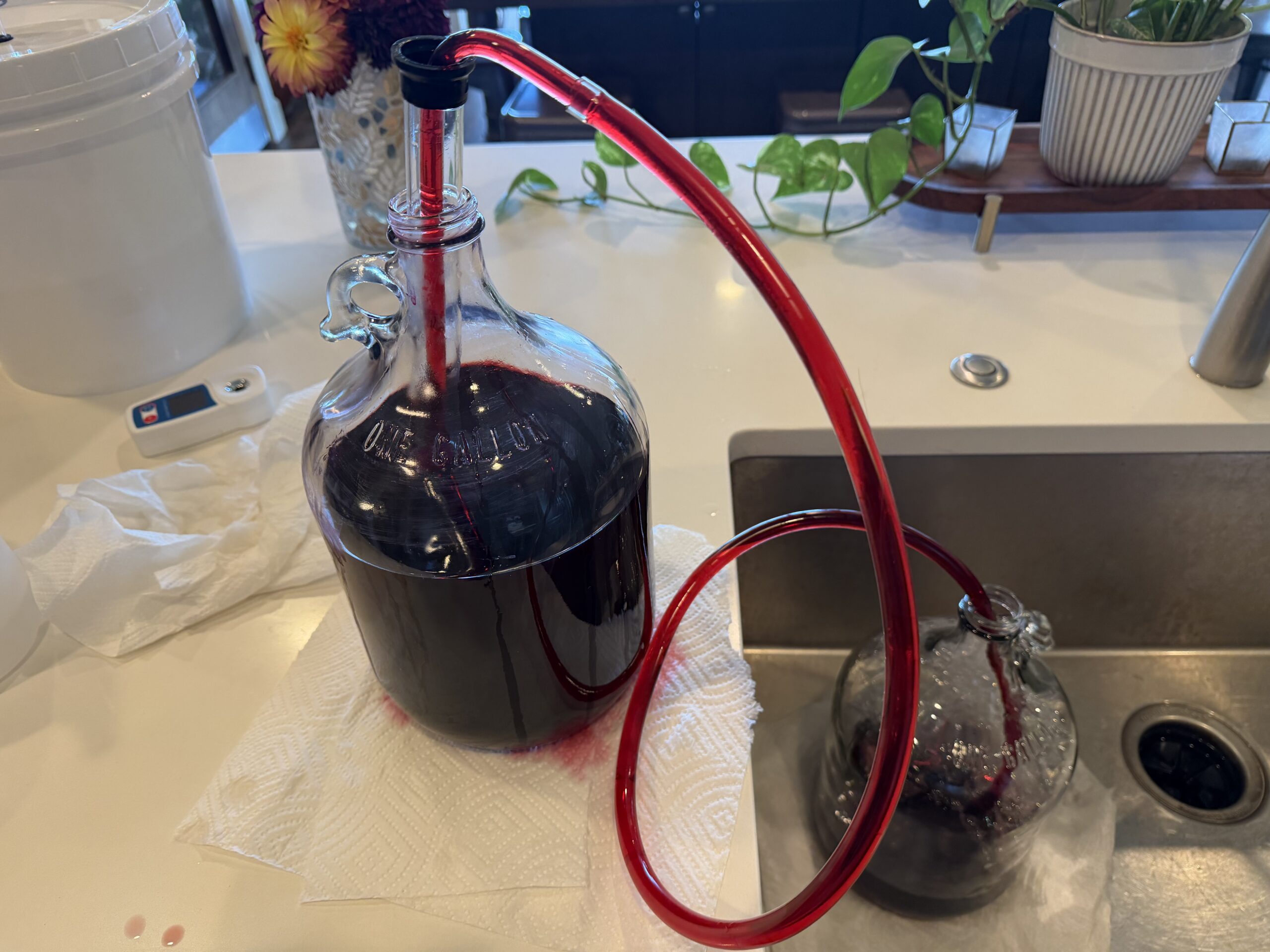
A glass carboy of dark purple blackberry wine on a kitchen counter, with a red siphon tube arcing from it into a second carboy sitting lower in the sink.

The blackberry’s second racking. The receiving carboy sits lower so gravity does the work.

The pear got lucky. I’d made a little more than the carboy could hold, so the loss came out of the surplus, and the surplus was just enough for one hydrometer reading. The mead lost four ounces to its lees, about 3% of the batch. The blackberry’s second racking lost eight, about 6%, and not all of that was sediment: the auto-siphon simply couldn’t reach into the corners of the carboy. The shape of the vessel set part of the cost.

A carboy that isn’t full has headspace, and headspace is air, and air is how wine oxidizes. So the gap has to be filled with something. For the mead, I topped it back up with four ounces of honey water, made from the same fireweed honey, at 18.4 Brix, which means the mead now has a little fresh sugar in it, on purpose, and the log says so. For the blackberry, I didn’t have anything worth adding, so I used an inert gas instead. It doesn’t replace the missing wine. The carboy holds less than it did, and nothing will change that. What the gas does is protect the wine that’s left, by keeping oxygen away from it.

That’s an honest cost, and it’s the right trade. Chasing the last few ounces means stirring up the sediment you were trying to leave behind.

Memory boundaries have the same cost. A write-side filter conservative enough to keep out the sediment will sometimes discard something that would have been useful: a detail from a failed attempt, a tool output that mattered after all. That’s not a flaw in the approach. It’s the price of the boundary, and it’s usually far cheaper than the alternative. A memory store that has lost a few useful details is annoying. One that has absorbed a few confidently wrong ones is dangerous, because it doesn’t know which ones they are.

It’s worth separating the two kinds of loss, though, because the blackberry had both. Some of what stayed behind was sediment I chose to leave. The rest was wine the siphon physically couldn’t reach. Memory systems lose information the same two ways. Some is discarded by policy: a rule decided this didn’t deserve to persist. Some is lost to the equipment: a schema with no field for it, a fixed chunk size that splits it in half, a context limit that drops whatever came first. Nobody decided to lose that second kind, which is exactly why it goes unnoticed. The fixes are different, too. A bad policy gets a better rule. A bad vessel gets better equipment, and no amount of careful siphoning will reach a corner the tube can’t bend into.

And when the boundary leaves a gap, those two top-offs are worth remembering. Adding something real is fine when it’s deliberate and recorded: the mead’s top-off is a known liquid at a known strength, written down the day it went in. The trouble is filling the space with something that only looks like the real thing: a plausible guess, a synthesized summary, a default. That’s topping up with water and not mentioning it. It dilutes the record, and nobody can tell afterward which part was the wine. When there’s nothing real to add, do what the inert gas does. A record that says plainly this was discarded, and here’s why doesn’t restore what was lost. It protects everything downstream from treating the gap as something known. That’s the job: not filling the hole, but making sure nothing mistakes the hole for knowledge.

Sur lie is a decision

To be fair to the lees, some winemakers deliberately keep wine on them. Aging on the fine lees, the lighter sediment that remains after the first racking, is a traditional technique for adding texture and complexity. It’s called sur lie, and Muscadet and Champagne are built partly on it.

But notice how it’s done. It’s the fine lees, not the gross lees. It’s a specific choice made for a specific wine, often with regular stirring and attention. Nobody ends up with a sur lie wine because they forgot to rack.

The same is true in memory. Sometimes execution detail genuinely deserves to persist. A failed approach might be exactly the thing you want an agent to remember next time: we tried this, it doesn’t work, here’s why. That’s valuable. But it’s valuable because someone decided to keep it, labeled it as what it is, and recorded where it came from. A lesson learned from a failure is a different thing from the failure’s raw transcript sitting in the store, waiting to be mistaken for advice.

Keeping execution material can be the right call. Keeping it by default almost never is.

Rack at transitions, not constantly

One more practical lesson. Racking isn’t free for the wine either: every transfer exposes it to oxygen and handling. So you don’t rack constantly. You rack at transitions, when primary ends, after secondary, before bottling, at the points where the evidence says the wine has moved into a new state. The mead waited in primary until its readings held still, then moved once.

That maps well onto memory design. Rather than continuously streaming everything an agent touches into durable storage, the natural points to decide what persists are the transitions: when a task completes, when a conclusion is confirmed, when a session ends. Those are the moments when you can tell the wine from the sediment, because the process has finished producing both.

Racking your memory

Decide what persists at write time. Read-time filtering can’t undo what raw material did to summaries, embeddings, and derived facts while it sat in the store.

Archive evidence; don’t promote it. Keep raw transcripts for debugging and audit, somewhere the agent doesn’t retrieve from. Evidence and memory are different stores.

Assume execution produces sediment. Failed attempts, irrelevant retrievals, transient errors, and untrusted text are normal byproducts of useful work. Plan for them to exist; don’t plan for them to persist.

Expect more than one pass. The first boundary removes the obvious sediment. Time reveals the rest.

Accept the cost of the boundary. A good filter will occasionally discard something useful. That’s cheaper than keeping something wrong.

Know which losses are policy and which are equipment. Some information is dropped because a rule said so. Some is dropped because the schema, chunk size, or context limit couldn’t hold it. Only the first kind was a decision.

Fill gaps honestly. When the boundary leaves a hole, either add something real and record exactly what it was, or record that something was removed, so the gap is protected rather than mistaken for knowledge. Never top it up with plausible filler.

Make retention deliberate. When execution detail is worth keeping, keep it on purpose, label what it is, and record where it came from.

Rack at transitions. The best time to separate conclusions from sediment is when the process that produced them has finished.

The pear is clearing now, a few shades brighter than it was in the fermenter, though still not as clear as I’d hoped. The lees did their job. They just don’t get to come along for the rest of it.


Facebooktwitterredditlinkedinmail

Your AI Agent Shouldn’t Be Allowed to Write Whatever It Wants

Building a Write-Side Custody gate in Go

AI memory systems spend most of their design budget on retrieval. Which vector database? How should we chunk? Which embedding model? What should top_k be?

Those are useful questions, but they all arrive after something more consequential has already happened: the system decided that some piece of information deserved to become memory.

Consider an agent researching vendors for regulated workloads. It finds this statement:

Vendor X is approved for regulated workloads.

The source is Vendor X’s own marketing site.

The statement might be true. It might even be current. But the source does not have the authority to establish organizational security policy. If our agent writes it directly into durable memory, better retrieval will not save us. We have only made questionable evidence easier to find.

The problem is not storage. It is admission.

I’ve been calling the architectural boundary responsible for that decision Write-Side Custody. Let’s build a small one in Go.

What Write-Side Custody Does

A storage API answers a mechanical question:

Can I persist this object?

Write-Side Custody asks a different set:

  • Who is trying to write this?
  • Where did the information come from?
  • What authority is being claimed?
  • Is that source allowed to establish that authority?
  • Does policy permit this class of information to become durable?
  • What evidence should survive the decision?

Only after those are answered should storage become involved.

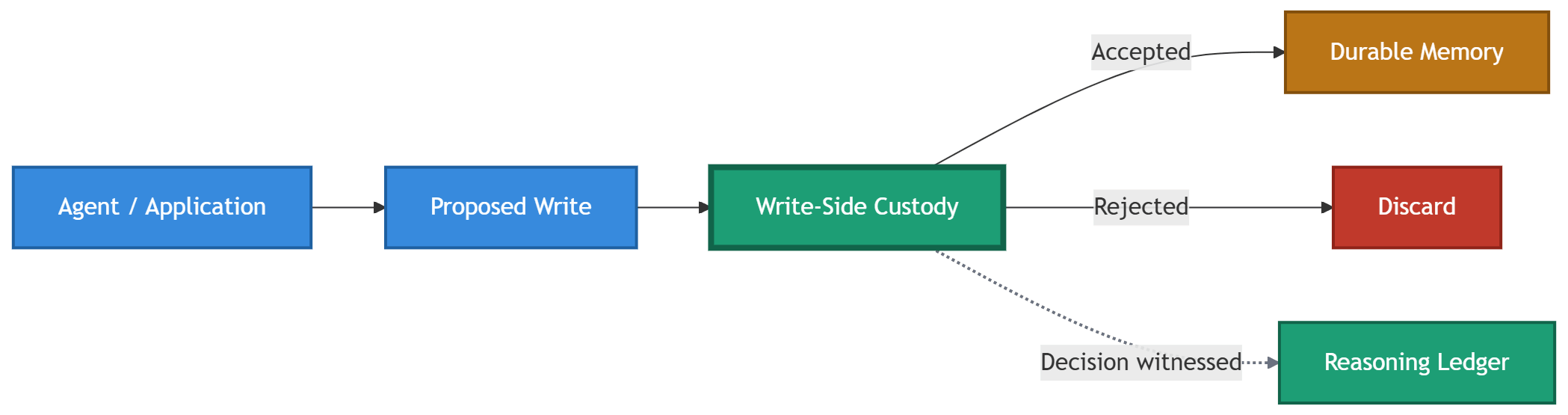
Flowchart showing a proposed write travelling from an agent or application into a Write-Side Custody gate. The gate routes accepted writes to durable memory and rejected writes to discard, while a dotted line records the decision in a Reasoning Ledger.

Note that the Reasoning Ledger does not make the decision. Custody enforces. The ledger witnesses. That separation matters a great deal once these systems have to be examined later.

Start With the Proposed Write

Go gives us a useful property for this experiment: we can make the things crossing our boundary explicit.

type ProposedWrite struct {
    Content          string
    Source           string
    ProducedBy       string
    ClaimedAuthority string
}

Our research agent might produce:

write := ProposedWrite{
    Content:          "Vendor X is approved for regulated workloads.",
    Source:           "https://vendorx.example.com/why-vendorx",
    ProducedBy:       "research-agent-run-4471",
    ClaimedAuthority: "security-policy",
}

Nothing in this structure says the statement is false, and that’s intentional. Write-Side Custody is not a universal truth detector. It determines whether a proposed write satisfies the rules governing this particular memory system.

For this system, a vendor marketing page cannot establish internal security policy. So we need policy.

Make Authority Explicit

First, two types. Authorities and source classes are different kinds of thing, and there is no situation in which we want to accidentally use one where the other belongs:

type Authority string
type SourceType string

Now we can define which source classes may establish which authorities:

type Policy struct {
    AuthoritySources map[Authority][]SourceType
}

var policy = Policy{
    AuthoritySources: map[Authority][]SourceType{
        "security-policy": {
            "internal-security-policy",
            "security-authority",
        },
        "user-preference": {
            "user",
        },
        "application-state": {
            "application",
            "runtime",
        },
    },
}

In production this comes from a policy service or configuration layer rather than a Go literal. The important part is that the relationship exists independently of whatever the agent claims. The agent does not get to decide that a marketing page constitutes security authority simply because it found one saying something useful.

Give the Gate a Verdict

type Verdict string

const (
    Allow Verdict = "ALLOW"
    Deny  Verdict = "DENY"
)

type CustodyDecision struct {
    Verdict   Verdict
    Reason    string
    Timestamp time.Time
}

Now the gate itself:

func EvaluateWrite(
    write ProposedWrite,
    sourceType SourceType,
    policy Policy,
) CustodyDecision {
    allowedSources, ok :=
        policy.AuthoritySources[Authority(write.ClaimedAuthority)]

    if !ok {
        return CustodyDecision{
            Verdict:   Deny,
            Reason:    "unknown claimed authority",
            Timestamp: time.Now().UTC(),
        }
    }

    for _, allowed := range allowedSources {
        if sourceType == allowed {
            return CustodyDecision{
                Verdict:   Allow,
                Reason:    "source may establish claimed authority",
                Timestamp: time.Now().UTC(),
            }
        }
    }

    return CustodyDecision{
        Verdict:   Deny,
        Reason:    "source cannot establish claimed authority",
        Timestamp: time.Now().UTC(),
    }
}

Two decisions in there are worth surfacing.

The first is that conversion on the map lookup. ProposedWrite holds plain strings because that’s what arrives over the wire, deserialized from JSON we did not write. Authority(write.ClaimedAuthority) is the moment an untrusted string becomes a term in our governance vocabulary, and it happens inside the gate rather than at the edge of the process. That’s the right place for it. Custody is precisely the layer where foreign input earns domain meaning.

The second is that sourceType is a separate parameter. It is not a field on ProposedWrite.

That is deliberate. Source classification is a judgment about the write, not a property the writer gets to assert about itself. If sourceType lived on the struct, our agent could label its own marketing page internal-security-policy and the gate would cheerfully agree. The classifier belongs to the custody layer, or to a runtime component that can independently observe where the content came from.

Small signature choice. Most of the security property.

Our vendor claim now reaches the boundary:

decision := EvaluateWrite(write, "vendor-marketing", policy)

fmt.Println(decision.Verdict)
fmt.Println(decision.Reason)

And receives:

DENY
source cannot establish claimed authority

The statement never becomes durable memory. We did not store questionable evidence and hope retrieval would eventually sort things out. We governed the write while the evidence and its provenance were still in hand.

The full gate, the policy, and a table-driven test suite covering the cases above are in memory-stack-patterns. Standard library only, so go test ./... and go run ./cmd/demo work on a clean checkout with nothing to install.

Don’t Throw Away the Rejection

Rejecting a write does not make the decision useless.

Imagine someone asks six months later:

Why doesn’t the system remember that Vendor X was approved?

“I don’t know” is not a satisfying answer, and in a regulated environment it isn’t an acceptable one either.

The custody decision is observable system behavior, which makes it a candidate for a Reasoning Ledger record:

type LedgerEntry struct {
    ID               string
    Timestamp        time.Time
    Actor            string
    Action           string
    Verdict          Verdict
    Reason           string
    Source           string
    ClaimedAuthority string
}

Our gate emits:

entry := LedgerEntry{
    ID:               newID(),
    Timestamp:        decision.Timestamp,
    Actor:            write.ProducedBy,
    Action:           "durable-memory-write",
    Verdict:          decision.Verdict,
    Reason:           decision.Reason,
    Source:           write.Source,
    ClaimedAuthority: write.ClaimedAuthority,
}

(newID is a few lines over crypto/rand, which keeps the whole example dependency-free.)

This entry is deliberately simplified. A ledger you would actually rely on needs a canonical serialization, a hash chain linking each entry to its predecessor, and some defense against tail truncation, because an append-only log that anyone can quietly shorten is not append-only.

Even the timestamp is less innocent than it looks. time.Now() gives you whatever precision the host clock offers, and JSON drops trailing zeros, so two entries can serialize at different widths. Hash a chain over a non-deterministic encoding and you have hashed nothing. The repo linked above truncates to a fixed precision and formats with a fixed-width layout for exactly that reason.

The Python implementation in the Sovereign Systems SDK does all three, which is part of why the Go exercise interests me. The hard parts are already solved somewhere. The open question is what happens to the boundary when it moves.

What matters here is the shape of what survives. The rejected statement still doesn’t enter memory. What persists is evidence that a write was proposed, evaluated, and rejected under a named rule. That is a different kind of information than the claim itself, and it’s the kind that answers questions later.

The Agent Doesn’t Get to Grade Its Own Homework

There’s a further boundary hiding in the payload. Suppose our agent sends:

{
  "content": "Vendor X is approved for regulated workloads.",
  "source": "https://vendorx.example.com/why-vendorx",
  "claimed_authority": "security-policy",
  "retrieval_method": "fresh",
  "policy_verified": true
}

Should we believe the last two fields?

There is an epistemic difference between:

The agent says it performed a fresh retrieval.

and:

The runtime that performed the HTTP request witnessed a fresh retrieval.

The same distinction applies to tool execution, timestamps, approval events, and policy versions. A stronger custody boundary therefore doesn’t only ask whether a record may be written. It asks:

Is this writer authorized to assert this particular kind of claim?

The agent legitimately owns claims about itself: its decision, the alternatives it considered, its confidence, the unknowns it identified. The runtime should mint the facts it can independently witness. Custody should not promote the former into the latter merely because both arrived in valid JSON.

This is the same principle as the sourceType parameter, applied one level up.

Why Do This at Write Time?

You could defer all of this to retrieval. Store everything, attach metadata, and let the reader decide what governs.

But then every questionable write becomes something every future reader has to reason around. It consumes storage. It becomes eligible for retrieval. It competes for context. It can be summarized, embedded, and propagated into records that no longer carry its provenance. And once provenance is gone, a future system may not have enough information to work out why the record was questionable in the first place.

A bad write today becomes bad context tomorrow.

Write-Side Custody puts the decision at the moment the system has the best possible view of what it is admitting.

Why Go?

None of this architecture requires Go, which is partly why I wanted to build it in Go.

A custody gate is a boundary service, and Go fits that role: explicit data structures, unremarkable HTTP services, small deployable binaries, and a type system strong enough to make the important distinctions visible without taking over the implementation.

The Authority and SourceType declarations we needed earlier are the clearest example. They cost one line each, and in exchange the compiler now refuses to let a source class be used where an authority belongs. That distinction would otherwise have lived in a variable name and a hope.

The same move applies elsewhere:

type Verdict string
type ActorType string

At which point the function signatures start expressing the vocabulary of the governance system rather than just its plumbing. EvaluateWrite doesn’t take three strings. It takes a proposed write, a source classification, and a policy, and no caller can shuffle them by accident.

Go didn’t create the architecture. It made the contracts hard to leave implicit.

Memory Begins Before Storage

Vector databases are very good at answering questions about similarity. They cannot tell us whether something deserved to become memory.

That’s an architecture decision, and by the time retrieval surfaces the problem, the questionable record may already have shaped dozens of others.

Give the proposed write provenance. Give the boundary policy. Give the decision evidence. Then let storage do what storage is good at.

Store what survived.


One thing I keep turning over: this boundary shouldn’t depend on Go. If Write-Side Custody only makes sense inside one language, it isn’t much of an architectural boundary. I’m curious what it would look like elsewhere. Would Rust’s type system make an invalid custody decision impossible to construct rather than merely inconvenient? Would Pydantic and FastAPI make the policy check feel so natural you’d stop noticing you were doing governance at all? If you’ve built something like this in your stack, I’d like to hear how the boundary changed shape.

Disclosure: I maintain the Sovereign Systems specification and SDK, which is where the vocabulary in this post comes from. The Go code here is a reference implementation written to test whether the idea travels, not a product.

Facebooktwitterredditlinkedinmail