The Backyard Quarry, Part 8: From Rocks to Reality

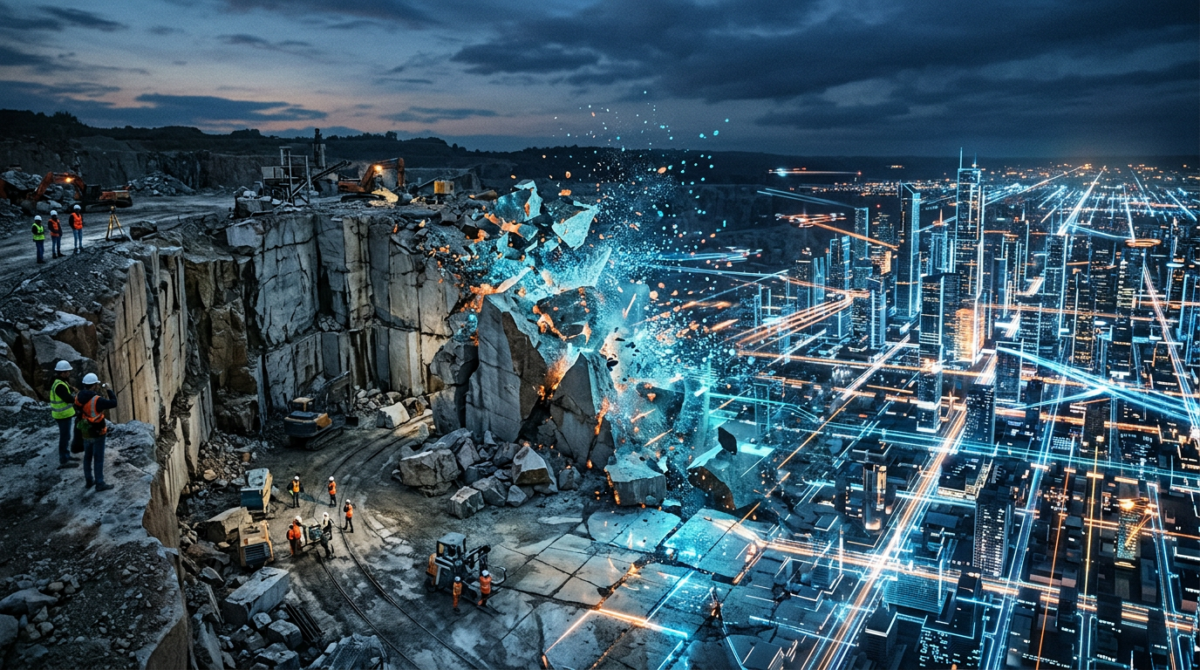
At the beginning of this series, the problem seemed simple.

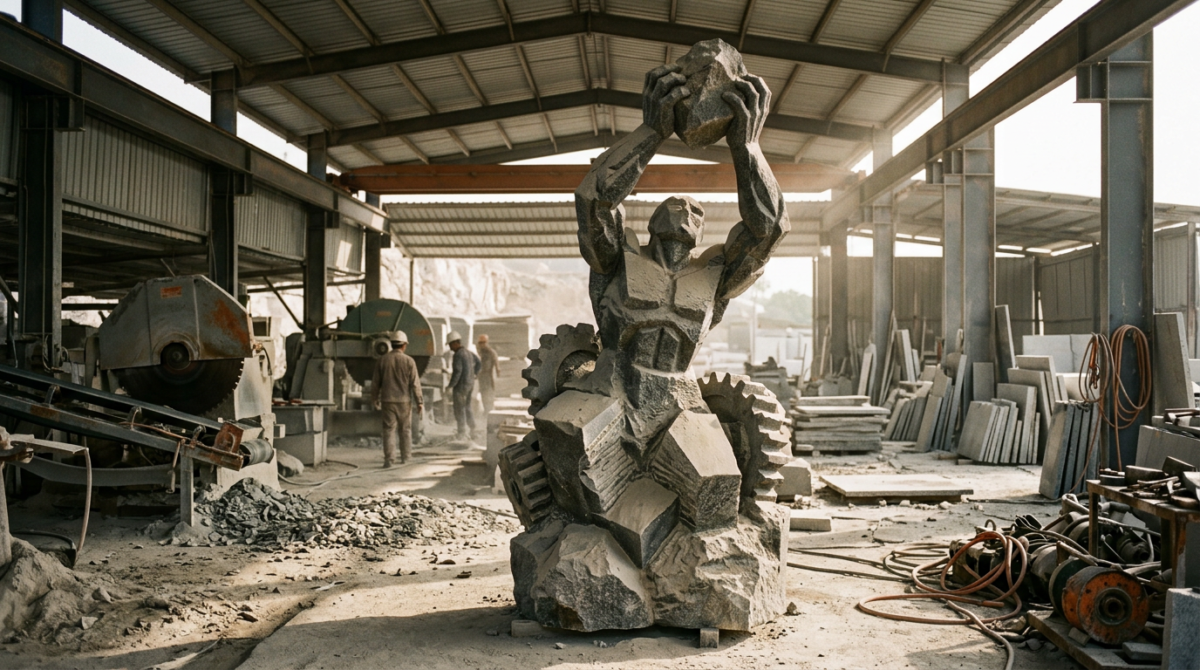
There were a lot of rocks in the yard.

Some were small.

Some were large.

A few were firmly in what I’ve been calling Engine Block Class.

The original idea was straightforward: catalog them, maybe sell a few, and build a small system around the process.

Along the way, the project grew.

What We Built

Across the previous posts, the Backyard Quarry gradually evolved into something more structured.

We explored:

  • designing a schema for physical objects
  • capturing images and measurements
  • building ingestion pipelines
  • indexing and searching the dataset
  • representing objects as digital twins
  • scaling the system as the dataset grows

None of these ideas are particularly new on their own.

But when combined, they form a recognizable structure.

The Pattern Behind the Project

What the Quarry experiment revealed is that many modern systems share the same underlying architecture.

It doesn’t matter whether the input is:

  • rocks in a backyard
  • industrial machine parts
  • museum artifacts
  • scanned environments
  • sensor data
  • documents or images

The pattern remains surprisingly consistent.

We start with the physical world.

We capture information from it.

We transform that information into structured data.

Then we build systems on top of that structure.

The Signature Architecture

At a high level, the pattern looks like this:
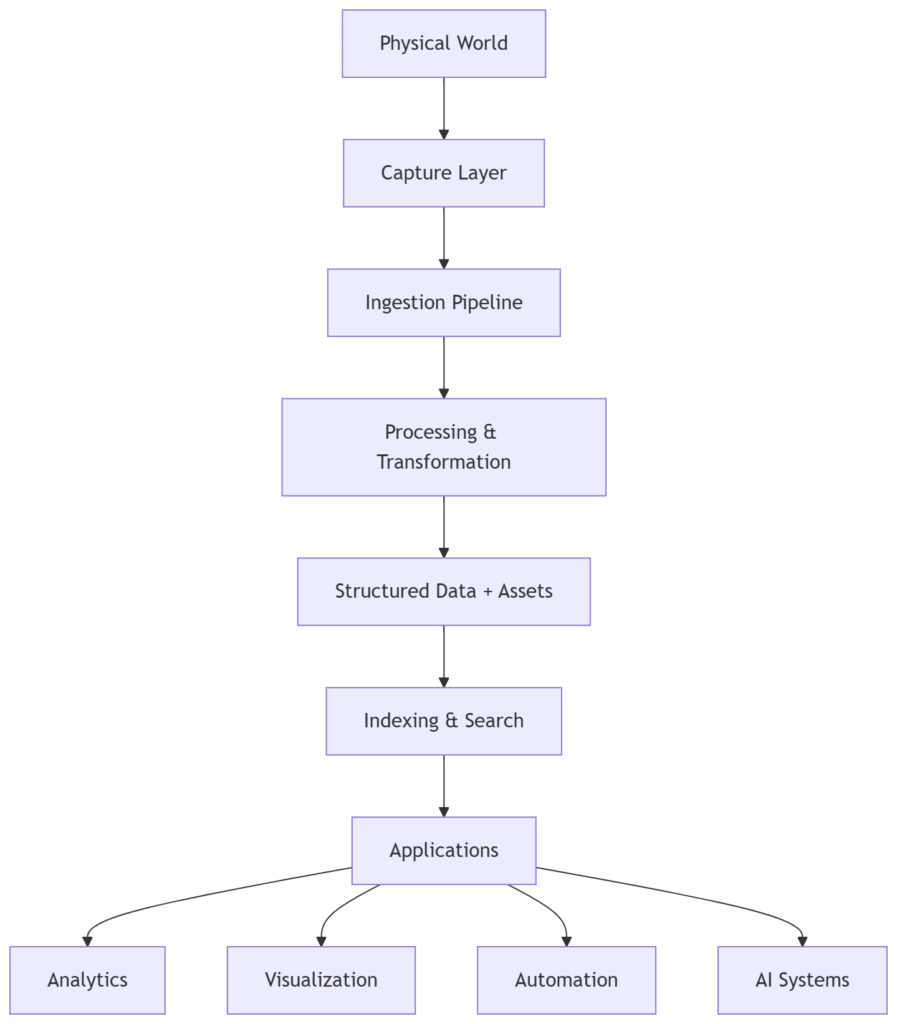
Diagram showing a system architecture where physical world inputs flow through capture, ingestion, processing, storage, indexing, and application layers.
A common architecture pattern for systems that transform real-world inputs into usable digital platforms.

Each layer has a role:

Capture Layer

The interface between the real world and the system.

Examples:

  • cameras
  • sensors
  • manual input
  • scanning systems

Ingestion Pipeline

Raw inputs enter the system.

Queues and ingestion services buffer incoming data.

This stage provides resilience and scalability.

Processing & Transformation

Raw inputs are converted into usable forms.

Examples:

  • metadata extraction
  • photogrammetry
  • feature generation
  • classification

Structured Data + Assets

The system stores both:

  • structured records
  • unstructured assets

This is where digital twins live.

Indexing & Search

Data becomes usable.

Indexes, embeddings, and search systems allow retrieval and exploration.

Applications

Finally, systems are built on top of the data:

  • dashboards
  • analytics
  • automation
  • AI systems

Recognizing Systems

One of the more interesting outcomes of the Quarry project is how quickly the pattern became recognizable.

Once you see it, it’s hard to miss.

Manufacturing systems follow this structure.

Archival systems follow this structure.

Many modern AI systems follow this structure.

Even systems designed to analyze motion or sensor data follow this structure.

Different inputs.

Same architecture.

Systems Thinking

The biggest shift in perspective comes when you stop thinking about individual objects and start thinking about the system as a whole.

Instead of asking:

  • How do we catalog this rock?

You start asking:

  • How does the system handle many objects over time?

This change in perspective leads to different kinds of decisions:

  • how pipelines are structured
  • how data flows through the system
  • how failures are handled
  • how the system evolves

At that point, the problem is no longer about objects.

It’s about systems.

A Small Experiment

The Backyard Quarry began as a small experiment.

A dataset that happened to be available.

A problem that seemed simple.

But small experiments are often useful.

They allow ideas to emerge in a manageable setting.

The same architectural questions that appear in large organizations also appear here — just at a smaller scale.

The Real Takeaway

The real lesson from the Quarry isn’t about rocks.

It’s about recognizing patterns.

Modern systems often share common structures.

Once you understand those structures, it becomes easier to design new systems.

You start to see the same ideas appearing in different places.

And that recognition becomes a powerful tool.

One Last Observation

Some engineering lessons come from large projects.

Others come from experiments.

Occasionally, they come from a pile of rocks in the backyard.

And if you happen to need a carefully documented specimen from the Backyard Quarry, inventory may still be available.

Shipping, however, remains an unsolved optimization problem.

The Rock Quarry Series

Facebooktwitterredditlinkedinmail

The Backyard Quarry, Part 7: Systems Beyond the Backyard

By now, the Backyard Quarry system has grown beyond its original intent.

We started with a pile of rocks.

We ended up with:

  • a schema
  • a capture process
  • a processing pipeline
  • storage and indexing
  • digital representations of physical objects

Along the way, something interesting happened.

The problems stopped feeling unique.

Recognizing the Pattern

At first, the Quarry felt like a small, slightly absurd project.

But the more pieces came together, the more familiar it became.

The same structure appeared again and again:

  • capture data from the physical world
  • transform it into structured representations
  • store it
  • index it
  • build systems on top of it

This isn’t a rock problem.

It’s a pattern.

Where the Pattern Appears

Once you start looking for it, you see it everywhere.

Manufacturing Systems

Physical parts become digital records.

  • components are tracked
  • condition is monitored
  • systems are modeled

Each part has a digital twin.

The system keeps everything connected.

Museums and Archives

Artifacts are cataloged and preserved.

  • metadata describes objects
  • images and scans capture detail
  • provenance tracks history

The goal is the same:

Turn physical objects into structured, searchable systems.

Photogrammetry and 3D Capture

Entire environments can be captured and reconstructed.

  • objects become meshes
  • scenes become models
  • real-world geometry becomes data

This is the Quarry pipeline, scaled up.

AI and Document Systems

Even text-based systems follow the same pattern.

  • raw documents are ingested
  • processed into structured formats
  • indexed for retrieval
  • used by applications

The inputs are different.

The structure is familiar.

Healthcare and Motion

Human movement becomes data.

  • sensors capture motion
  • signals are processed
  • patterns are analyzed
  • systems track change over time

This is where the idea of digital twins becomes more dynamic.

Not just objects.

But behavior.

The Common Structure

Across all of these domains, the same core system emerges.

It doesn’t matter whether the input is:

  • a rock
  • a machine part
  • an artifact
  • a document
  • a human movement pattern

The architecture is remarkably consistent.

Capture.

Process.

Store.

Index.

Use.

The Value of Abstraction

One of the more useful realizations from the Quarry project is this:

The value isn’t in the specific object.
It’s in the system that handles it.

Once you understand the pattern, you can apply it in different contexts.

The details change.

The structure remains.

Systems, Not Features

At a certain point, it becomes less useful to think in terms of features.

Instead, the focus shifts to systems.

Questions change.

Instead of:

  • How do we store this object?
  • How do we search this dataset?

You start asking:

  • How does data move through the system?
  • Where are the bottlenecks?
  • How do we handle growth?
  • How do we handle imperfect inputs?

These are system-level questions.

The Real Takeaway

The Backyard Quarry started as a simple, somewhat comical, experiment.

But it revealed something broader.

Many modern systems are built on the same foundation:

  • transforming real-world inputs into structured data
  • building pipelines around that transformation
  • enabling search, analysis, and interaction

The objects change.

The pattern doesn’t.

Looking Back

It’s a little surprising how far the idea traveled.

From:

  • a pile of rocks

To:

  • data modeling
  • ingestion pipelines
  • search systems
  • digital twins
  • scalable architectures

And now:

  • recognizing patterns across industries

Not bad for something that started in the backyard.

What Comes Next

There’s one final step.

So far, we’ve explored:

  • how to model objects
  • how to capture them
  • how to store and search them
  • how systems scale
  • how patterns repeat

In the final post, we’ll bring everything together.

A single view of the system.

A way to think about it as a whole.

Because once you can see the full structure, the pattern becomes difficult to miss.

And at that point, it becomes clear that the Quarry was never really about rocks.

It was about learning to recognize systems.

The Rock Quarry Series

Facebooktwitterredditlinkedinmail