The Backyard Quarry, Part 7: Systems Beyond the Backyard

By now, the Backyard Quarry system has grown beyond its original intent.

We started with a pile of rocks.

We ended up with:

  • a schema
  • a capture process
  • a processing pipeline
  • storage and indexing
  • digital representations of physical objects

Along the way, something interesting happened.

The problems stopped feeling unique.

Recognizing the Pattern

At first, the Quarry felt like a small, slightly absurd project.

But the more pieces came together, the more familiar it became.

The same structure appeared again and again:

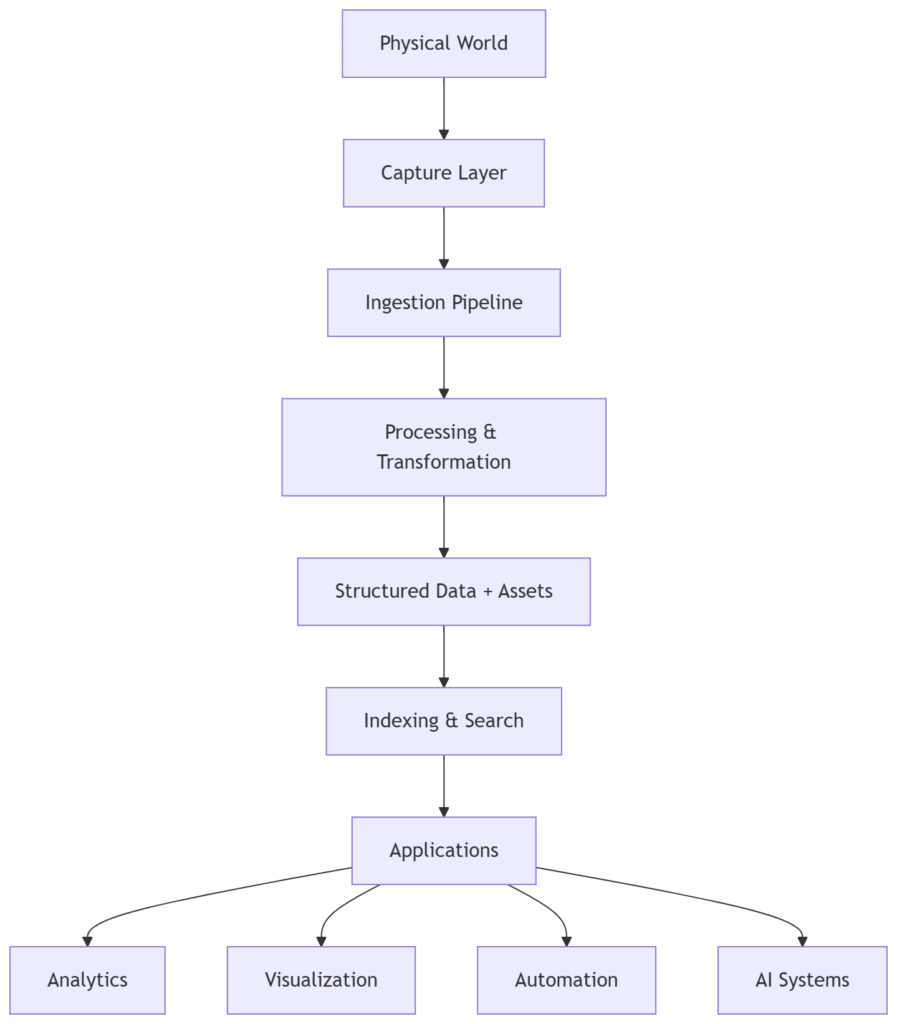
  • capture data from the physical world
  • transform it into structured representations
  • store it
  • index it
  • build systems on top of it

This isn’t a rock problem.

It’s a pattern.

Where the Pattern Appears

Once you start looking for it, you see it everywhere.

Manufacturing Systems

Physical parts become digital records.

  • components are tracked
  • condition is monitored
  • systems are modeled

Each part has a digital twin.

The system keeps everything connected.

Museums and Archives

Artifacts are cataloged and preserved.

  • metadata describes objects
  • images and scans capture detail
  • provenance tracks history

The goal is the same:

Turn physical objects into structured, searchable systems.

Photogrammetry and 3D Capture

Entire environments can be captured and reconstructed.

  • objects become meshes
  • scenes become models
  • real-world geometry becomes data

This is the Quarry pipeline, scaled up.

AI and Document Systems

Even text-based systems follow the same pattern.

  • raw documents are ingested
  • processed into structured formats
  • indexed for retrieval
  • used by applications

The inputs are different.

The structure is familiar.

Healthcare and Motion

Human movement becomes data.

  • sensors capture motion
  • signals are processed
  • patterns are analyzed
  • systems track change over time

This is where the idea of digital twins becomes more dynamic.

Not just objects.

But behavior.

The Common Structure

Across all of these domains, the same core system emerges.

It doesn’t matter whether the input is:

  • a rock
  • a machine part
  • an artifact
  • a document
  • a human movement pattern

The architecture is remarkably consistent.

Capture.

Process.

Store.

Index.

Use.

The Value of Abstraction

One of the more useful realizations from the Quarry project is this:

The value isn’t in the specific object.
It’s in the system that handles it.

Once you understand the pattern, you can apply it in different contexts.

The details change.

The structure remains.

Systems, Not Features

At a certain point, it becomes less useful to think in terms of features.

Instead, the focus shifts to systems.

Questions change.

Instead of:

  • How do we store this object?
  • How do we search this dataset?

You start asking:

  • How does data move through the system?
  • Where are the bottlenecks?
  • How do we handle growth?
  • How do we handle imperfect inputs?

These are system-level questions.

The Real Takeaway

The Backyard Quarry started as a simple, somewhat comical, experiment.

But it revealed something broader.

Many modern systems are built on the same foundation:

  • transforming real-world inputs into structured data
  • building pipelines around that transformation
  • enabling search, analysis, and interaction

The objects change.

The pattern doesn’t.

Looking Back

It’s a little surprising how far the idea traveled.

From:

  • a pile of rocks

To:

  • data modeling
  • ingestion pipelines
  • search systems
  • digital twins
  • scalable architectures

And now:

  • recognizing patterns across industries

Not bad for something that started in the backyard.

What Comes Next

There’s one final step.

So far, we’ve explored:

  • how to model objects
  • how to capture them
  • how to store and search them
  • how systems scale
  • how patterns repeat

In the final post, we’ll bring everything together.

A single view of the system.

A way to think about it as a whole.

Because once you can see the full structure, the pattern becomes difficult to miss.

And at that point, it becomes clear that the Quarry was never really about rocks.

It was about learning to recognize systems.

The Rock Quarry Series

Facebooktwitterredditlinkedinmail

The Backyard Quarry, Part 5: Digital Twins for Physical Objects

At this point in the Backyard Quarry project, something subtle has happened.

We started with a pile of rocks.

We now have:

  • a schema
  • a capture process
  • stored images
  • searchable metadata
  • classification
  • lifecycle states

Each rock has a record.

Each record represents something in the physical world.

And that leads to a useful observation.

We’re no longer just cataloging rocks.

We’re building digital representations of them.

What Is a Digital Twin?

In simple terms, a digital twin is:

A structured digital representation of a physical object.

That representation can include:

  • identity
  • properties
  • visual data
  • state
  • history

In the context of the Quarry, a rock’s digital twin might look like:

rock_id: QRY-042
weight_lb: 12.3
dimensions_cm: 18 x 10 x 7
color: gray
rock_type: granite
status: for_sale
images: [rock_042_1.jpg, rock_042_2.jpg]
model: rock_042.obj

It’s not the rock itself.

But it’s a useful abstraction of it.

More Than Just Metadata

At first glance, a digital twin might look like a simple database record.

But there’s an important difference.

A well-designed digital twin combines multiple types of data:

  • structured metadata (easy to query)
  • unstructured assets (images, models)
  • derived attributes (classification, embeddings)
  • state over time

It’s not just describing the object.

It’s enabling interaction with it through software.

The Time Dimension

One of the most important aspects of a digital twin is that it can change over time.

Even a rock — which is about as static as objects get — has a lifecycle in the system:

collected → cataloged → listed_for_sale → sold

Each transition adds context.

Now we’re not just storing a snapshot.

We’re tracking a history.

This becomes much more important in other domains.

Where This Shows Up

The interesting part is that this pattern isn’t unique to rocks.

It appears in many different systems.

Manufacturing

  • digital twins of machine parts
  • tracking condition and usage
  • linking physical components to system data

Museums and Archives

  • artifacts with metadata, images, provenance
  • digitized collections
  • searchable historical records

Agriculture

  • crops tracked over time
  • environmental data
  • growth and yield metrics

Healthcare and Motion

  • human movement captured as data
  • gait analysis
  • rehabilitation tracking

This last one starts to look a lot like something else entirely.

From Objects to Systems

What the Backyard Quarry demonstrates, in a small way, is that once you:

  • represent objects as data
  • capture their properties
  • store and index them

you’ve created the foundation for a larger system.

The digital twin becomes a building block.

And systems are built from collections of these building blocks.

The Abstraction Layer

A useful way to think about digital twins is as an abstraction layer.

They sit between:

Diagram showing how physical objects are captured and represented as digital twins with metadata, assets, and application layers.
Digital twins act as a bridge between physical objects and software systems.

Applications don’t interact with rocks directly.

They interact with the representation of rocks.

That layer enables:

  • search
  • analytics
  • visualization
  • automation

Without it, everything remains manual and unstructured.

The Limits of the Model

Of course, digital twins are not perfect representations.

They are approximations.

Some properties are easy to capture.

Others are difficult or impossible.

Even in the Quarry:

  • weight is approximate
  • dimensions are imprecise
  • visual data depends on lighting
  • 3D models may be incomplete

The goal isn’t perfect fidelity.

It’s usefulness.

The Real Insight

At this point, the Backyard Quarry starts to feel less like a joke and more like a small version of a much larger idea.

Many modern systems are built around digital twins.

Not because the concept is new.

But because we now have the tools to make it practical:

  • cheap sensors
  • high-resolution cameras
  • scalable storage
  • machine learning

The pattern has existed for a long time.

The difference is that we can now implement it at scale.

What Comes Next

So far, the Quarry system works at a small scale.

A handful of rocks.

A manageable dataset.

But what happens when the number of objects grows?

When the dataset becomes:

  • hundreds
  • thousands
  • or millions

The next post explores that question.

Because designing a system for a small dataset is one thing.

Designing a system that scales is something else entirely.

And somewhere along the way, it becomes clear that a pile of rocks is enough to illustrate ideas that show up across entire industries.

Yet another surprise in this Backyard Quarry journey.

The Rock Quarry Series

Facebooktwitterredditlinkedinmail