The Field Agent

(Identity, Input, and the Digital Twin of the Dirt)

We’ve spent the last month teaching an AI agent (the Digital Scribe) to read handwritten 1880 census cursive and build a social graph. It was a rigorous exercise in high-integrity, atomic knowledge mapping.

You might wonder what 19th-century ledgers have to do with a modern harvest. The answer is Identity. The same principles we used to track a person through history—giving them a unique, permanent ID and linking them to their family and home—apply directly to tracking a vineyard block over time. We aren’t just logging data; we are building a “life story” for your land.

But it’s mid-summer in Oregon, and the ledgers are dusty. The Pinot Noir and Maréchal Foch are heavy on the vine. It’s time to move from forensic history to the real-time resilience of The Agile Harvest.

The Mid-Summer Anxiety (The 70% Problem)

It’s 6:00 AM. You’re walking Row 12, checking the clusters. The forecast says 95°F by noon. The vineyard looks beautiful, but last night, you were looking at your contracts. You have 100 acres of prime fruit, and only 30% of it is spoken for.

The “70% Anxiety” is real. In a traditional model, that 70% unsold acreage is just risk—money you’ve spent on labor and trellis maintenance that might never come back. In a Sovereign Vineyard, that’s not risk; it’s a linked set of opportunities.

What do I mean by “Sovereign”? It means you own the “Brain.” Your sugar levels, your yields, and your profit margins stay on a local server you control—not in a third-party cloud app that sells your aggregate data back to big-box competitors.

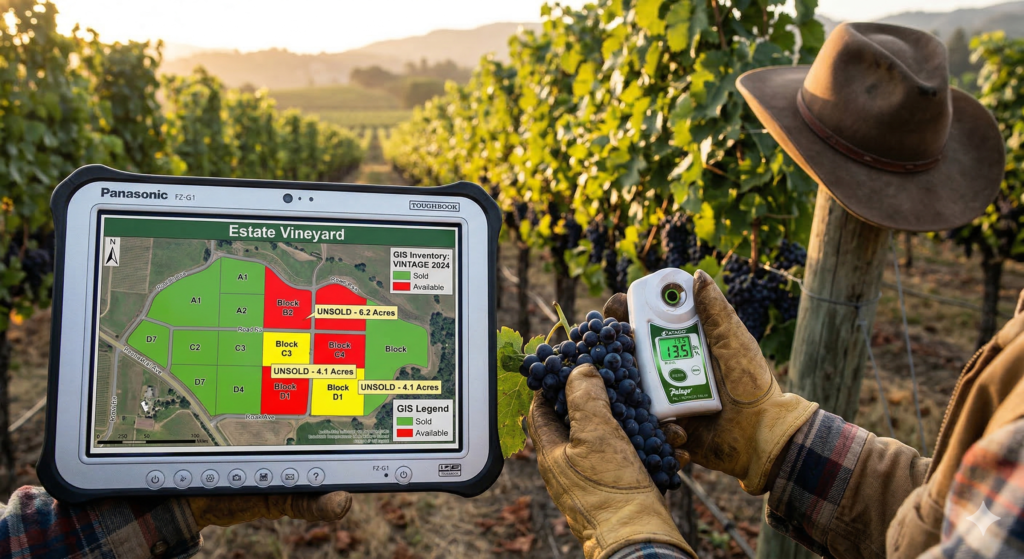
A rugged tablet displays a precision block map of a vineyard. A farmer's gloved hand holds a refractometer reading "13.5 Brix" next to a bunch of Pinot Noir grapes. Morning sunlight illuminates the scene.
Tactile Capture. The Sovereign system begins with high-integrity data. Whether you log it via a handheld refractometer or an advanced sensor array, the Field Agent’s goal is to turn that reading into a decision point.

The Clipboard-to-Sensor Agnosticism

A core pillar of The Agile Harvest is that the AI doesn’t care how the numbers get in, as long as they are accurate. This isn’t about expensive sensor arrays; it’s about Input Agnosticism.

  • The High-Tech Path: You have LoRaWAN soil moisture probes and automated brix samplers reporting every hour.
  • The “Flannel & Clipboard” Path: You are walking the rows, crushing a grape onto a prism, and typing “13.5 Brix” into a simple chat window on your phone.

To the Digital Scribe, a number is just a number. Whether it comes from a $5,000 automated probe or a handwritten note, once it enters the Knowledge Graph, it becomes a Decision Point.

The Field Agent in Action: The Reasoning Loop

This is where the “Field Agent” metaphor cashes out. Your agent isn’t just a database; it’s a strategic advisor watching the “trajectory” of your fruit.

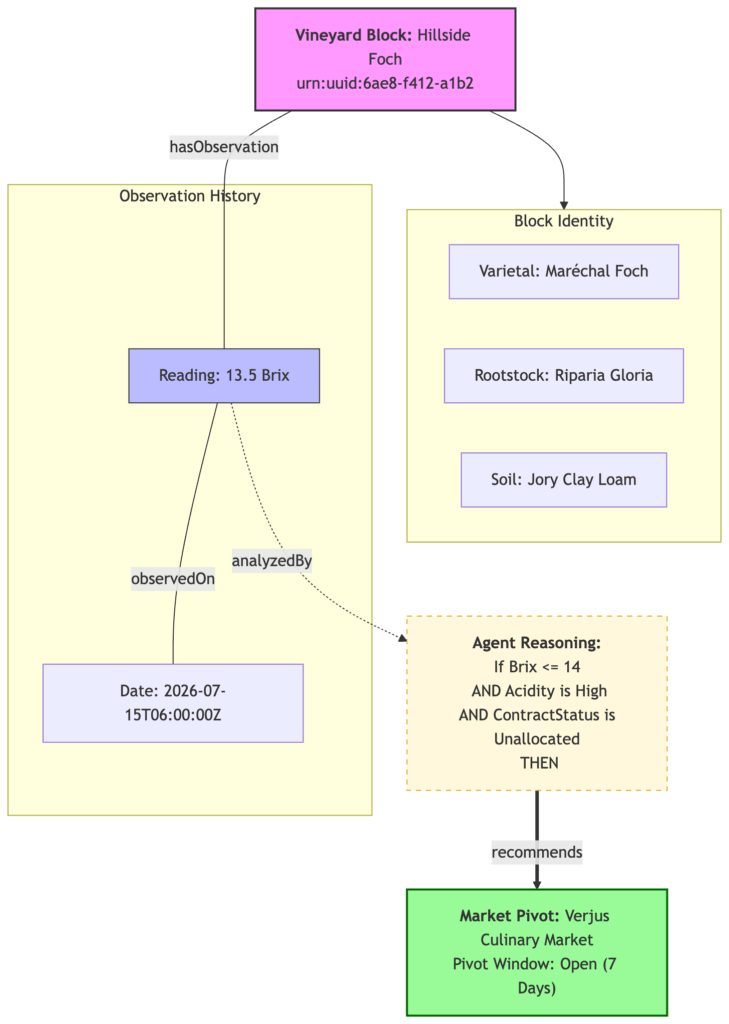
A Mermaid chart showing a central 'Vineyard Block' node linked to static identity nodes and a '13.5 Brix' observation. An 'Agent Reasoning' box analyzes the brix and recommends a 'Verjus Market Pivot' node. Solid lines show relationships, and dashed lines show agent analysis.
The Pivot Graph. This diagram illustrates how the Scribe moves from data to decision. The static Block Identity (Foch/Jory Soil) is the anchor. When a new Observation (13.5 Brix) is linked, the Agent reasons across its knowledge—contracts, weather, brix—and creates a new, prioritized link to a Market Pivot (Verjus) opportunity.

The Sunday Morning Exchange:

Farmer: “Scribe, I just logged a 13.5 Brix and pH of 3.0 on the Foch block. It’s early, but the heat is coming.”

Field Agent: “Copy that. That’s a 2-point sugar jump since Tuesday. Acidity is still very high. I’m cross-referencing our contract list: we still have 15 tons unallocated on this block. My weather tool predicts three days of 95°F+.”

Farmer: “What are my options if we don’t hold for the wine contract?”

Field Agent: “The ‘Verjus Window’ is open. Verjus (unripened green juice) requires high acid and low sugar—exactly what we have today. We are scheduled for green harvesting (thinning fruit) on Tuesday anyway. Instead of dropping that fruit to the mulch, we can divert it to the culinary market. Based on current spot prices, that 70% risk just became a 20% early-season revenue win.”

The Road Ahead

Identifying the “Verjus Window” is just the first step in The Agile Harvest. By treating your vineyard block as a “Digital Twin” with its own identity and history, we’ve built the foundation to pivot before the birds get your crop. Next, we’ll look at the “Pivot Engine” itself—how we connect our local graph to global market APIs to find the highest value for every cluster.

Digital Scribe Series (A Sovereign Path)

Are you facing similar mid-season jitters with unsold inventory or shifting markets? How are you handling the gap between what you grow and what you’ve sold? Reach out on LinkedIn and let’s start a conversation about how local-first AI can help you find your next “Agile Harvest” opportunity.

Facebooktwitterredditlinkedinmail

Engineering the Knowledge Archive

In our last post, we introduced the Digital Scribe, an AI architecture designed to capture the “unstructured nightmare” of historical records. We showed how the Scribe uses the Model Context Protocol (MCP) to transcribe 19th-century cursive and resolve the cryptic “ditto marks” of the past.

But transcription is only half the battle. If the Scribe forgets what it read the moment the session ends, we haven’t built a system; we’ve just built a fancy typewriter.

Today, we go deeper into the Scribe’s Memory.

Memory is an Engineering Discipline

As I’ve written before in Engineering Agent Memory, AI agents are often “stateless by default.” They live in the moment, relying on a flat conversation transcript that grows until it hits a token limit.

For the Digital Scribe, that is unacceptable. To digitize the 1880 Census of Salem, Oregon, we need Semantic Memory, a way to store, index, and retrieve knowledge intentionally.

The Architecture of Persistence: JSON-LD

We didn’t just want a text file; we wanted a Sovereign Archive. We chose JSON-LD (JSON for Linked Data) aligned with Schema.org standards. This transforms a census row into a “Thing, not a string.”

To achieve this, we don’t just dump JSON; we map our historical model to the Schema.org Person vocabulary. This ensures that a ‘Scribe’ in 2026 and a researcher in 2050 can both understand that a ‘birthplace’ string is actually a Schema.org/Place entity.

# Mapping the Census to the Global Schema
def _record_to_jsonld_entity(record: Census1880Record, entity_id: str | None = None) -> dict:
    given, family = _parse_historical_name(record.name)
    return {
        "@context": "https://schema.org/",
        "@type": "Person",
        "@id": entity_id or f"urn:uuid:{uuid.uuid4()}",
        "givenName": given,
        "familyName": family,
        "hasOccupation": {"@type": "Occupation", "name": record.occupation},
        "birthPlace": {"@type": "Place", "name": record.birthplace},
        "censusFamilyNumber": record.family_number,
        "censusDwellingNumber": record.dwelling_number,
    }

Technical Deep Dive: Parsing Historical Names

In 1880, names weren’t always “First Last.” We built a robust parser to handle “Surname, Given Name” formats and multi-word surnames. Without this, our “Semantic Memory” would be fractured by simple formatting variances.

Input String givenName familyName
“Smith, John” “John” “Smith”
“Mary Ann Jones” “Mary Ann” “Jones”
“John Smith” “John” “Smith”

When the Scribe identifies “John Smith” in a ledger, it doesn’t just save a name. It creates a Schema.org/Person entity, complete with a unique urn:uuid: and structured links to his occupation and birthplace.

Atomic Ingestion: Protecting the History

Because we are building “Sovereign Infrastructure,” the integrity of the data is paramount. We implemented an Atomic Write Pattern to ensure the archive is never corrupted.

  1. Thread-Safety: A global lock ensures that multiple “Scribe” agents don’t collide when writing to the same archive.
  2. Write-Ahead Strategy: The system writes to a temporary file and uses os.replace only after the data is verified.
  3. Durability: We use os.fsync to ensure the data is physically flushed to the disk, protecting against power loss or OS crashes.

By using a write-to-temp pattern followed by an os.fsync, we ensure that the data is physically committed to the platter before we ever swap it into the main archive. This prevents ‘half-written’ files if the power cuts or the process crashes.

# The "Sovereign" Atomic Save
def _save_graph(self, entities: list[dict]) -> None:
    tmp_path = self._path.with_suffix(self._path.suffix + ".tmp")
    replaced = False
    try:
        with open(tmp_path, "w", encoding="utf-8") as f:
            json.dump(entities, f, indent=2, ensure_ascii=False)
            f.write("\n")
            f.flush()
            os.fsync(f.fileno()) # Force the OS to flush to disk
        os.replace(tmp_path, self._path) # Atomic swap
        replaced = True
    finally:
        if not replaced and tmp_path.exists():
            tmp_path.unlink() # Cleanup if we failed

The Recall: Deduplication and Entity Intelligence

The true power of the Scribe’s memory is revealed during Ingestion. If we attempt to capture the same person twice, the Scribe doesn’t just blindly append the data. It performs a Deduplication Check.

By hashing the record’s “DNA” (Name, Dwelling, and Family Number), the Scribe recognizes “John Smith” from a previous run and skips the ingestion, returning a duplicate_skipped status.

Deduplication is the ultimate test of a Scribe’s integrity. We define a unique fingerprint for each life, e.g. a combination of their Name, Dwelling, and Family Number. If the Scribe sees this ‘DNA’ again, it refuses to create a duplicate, maintaining a clean, high-fidelity archive.

# The Knowledge Stewardship Guard
for e in entities:
    if (
        (e.get("givenName") or "") == given
        and (e.get("familyName") or "") == family
        and e.get("censusDwellingNumber") == record.dwelling_number
        and e.get("censusFamilyNumber") == record.family_number
    ):
        # Already exists—identify it and move on
        existing_id = e.get("@id") or f"{LEGACY_ID_PREFIX}{_content_hash(e)}"
        return (existing_id, False)

A detailed architectural diagram of the Digital Scribe's Semantic Memory layer. It shows the flow from structured JSON through name parsing and entity fingerprinting, into a persistent JSON-LD archive protected by threading locks, corruption guards, and fsync durability.

Why This Matters: Building the Graph

By engineering a persistent, semantic memory, we’ve given the Scribe the ability to recall context across time.

In our next post, we will use this foundation to move from individual residents to The Knowledge Graph. We will begin linking families, neighborhoods, and migration patterns—turning a static archive into a living map of the past.

The Digital Scribe isn’t just reading history anymore. It’s remembering it.

Facebooktwitterredditlinkedinmail