

Material Provenance

(Agentic Memory and the Digital Passport)

In moving into the workshop, we’re working on a Material-CV tool which performs geometric audits. We know we have 280 staves and exactly enough wide material for four side tables. But in the Salvaged Barrel Studio, we don’t just sell furniture; we sell a story.

To do that, every stave needs more than a measurement. It needs a Digital Passport.

The Stave as a Unique Entity

A barrel is a collective. When it arrives at the studio, it is a single unit. But the moment we pull the hoops, that unit shatters into thirty distinct staves. If we lose the connection between those staves and their origin, we lose the value of the “Sovereign” chain we built during the harvest.

We use a specialized JSON-LD schema to ensure that material memory is never lost. We aren’t just tagging wood; we are tagging a specific individual product. We are tracking a unique ID, like urn:uuid:stave-foch-2022-b4-042, and linking it to the metadata of Vineyard Block #4, the specific 2022 Maréchal Foch vintage, and the physical condition recorded during the initial scan.

Technical Note: If you want the deep-dive on how we design schemas for physical objects—from a pile of rocks to a stack of oak—check out our parallel series: The Backyard Quarry, Part 2: Designing a Schema for Physical Objects.

Tracking the Unpredictable: Labeling the Stave

How do we keep track of 280 pieces of curved oak without losing our minds? We use Agentic Labeling. As each stave passes through the CV scanner, the Scribe assigns its ID and generates a small, discreet laser-etched mark on the joint side of the wood where it will eventually be hidden by glue.
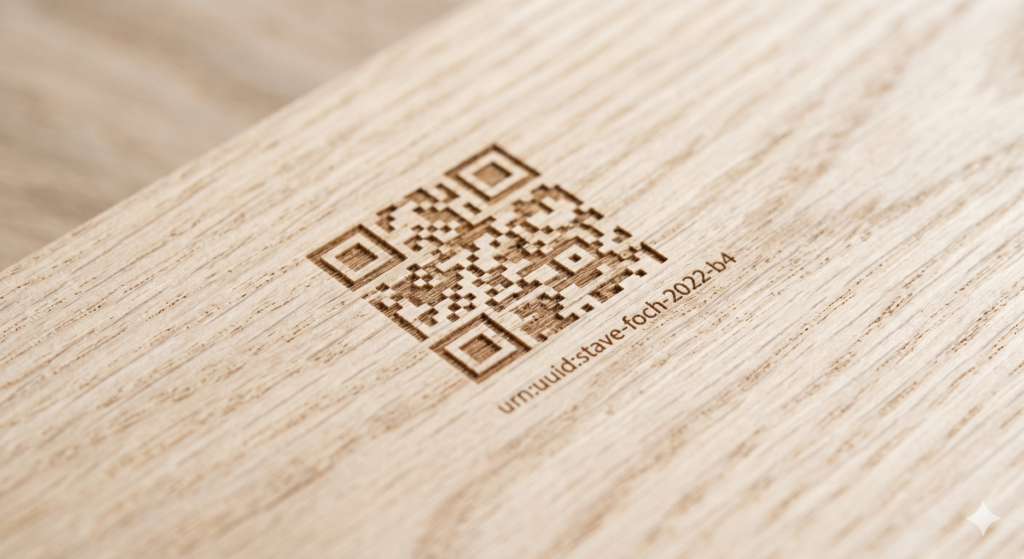
A macro close-up of the light-colored grain of a white oak board. A small, precise QR code is laser-etched into the wood grain. Next to the QR code, a series of tiny numbers read "urn:uuid:stave-foch-2022-b4". The lighting is soft and industrial, showing the texture of the wood fibers.
A macro shot of a laser-etched QR code on the side of an oak wood stave.


This mark is the anchor for the stave’s biography. It records everything from the “stress fractures” detected in the fiber to the “wine-stain depth” that tells us which side of the oak will provide the most dramatic aesthetic pop.

The Studio Exchange: The Memory Check

This is where the Supply Chain Guardian from our vineyard series shakes hands with the Master Woodworker.

Maker: “Scribe, I am ready to glue up the top for Table #1. I want to use the deep-stain staves from the Foch barrels. Which ones are they?”

Scribe: “I have filtered the inventory. You have 12 staves from the 2022 Foch harvest with a stain-depth greater than 3mm. I have highlighted their locations in Rack B, Section 4.”

Maker: “Wait, I see a hairline crack on Stave #042. Did we miss that?”

Scribe: “Checking the scan history for Stave #042. That fracture was present during the initial breakdown. I flagged it as non-structural at the time. My assessment: Use it for the center of the mosaic top where it will be reinforced by the surrounding joints, but do not use it for a leg-joint or a weight-bearing edge.”

The Digital Passport: Selling the Story

When the table is finished, the material memory doesn’t just disappear into the database. We use the Scribe to generate a Digital Passport for the customer.

By scanning a small mark on the underside of the table, the new owner can see the entire journey. They can see the 18°F frost that triggered the Ice Wine harvest, the cold-chain verification from the delivery truck, and the specific geometry of the staves used to build their piece.

This is no longer just a table; it is a verified, Sovereign artifact. You are selling the truth of the material, backed by the same architecture that saved 140-year-old names in a census ledger.

The Master Woodworker Series (Salvaged Barrel Studio)

How are you tracking the life story of your materials? Are you losing your provenance the moment you break down your raw inventory? Reach out on LinkedIn and let’s talk about building a Digital Passport for your craft.


Facebooktwitterredditlinkedinmail

The Pivot Engine

(Connecting the Local Twin to the Global Market)

In our last post, we built the “Digital Twin” of the dirt. We gave our vineyard blocks a permanent identity and a way to log real-time sugar and acid levels. But a Digital Twin is just a mirror; to survive a lopsided season, you need an Engine.

The Pivot Engine is the layer of our Sovereign AI that connects your private vineyard data to the public world of commodity prices, weather forecasts, and regional contracts. It moves us from “What is happening?” to “What should I do?”

The Scenario Planner: Beyond the “Hunch”

Every grower has a “gut feeling” about when to hold and when to fold. But when 70% of your crop is unallocated, a “hunch” is a high-stakes gamble. The Pivot Engine uses Scenario Planning to run a “What-If” analysis across your available outlets.

Feature Scenario A: The Waiting Game Scenario B: The Early Exit
Market Standard Wine (September) Culinary Verjus (Now)
Risk High. If no buyer appears, fruit rots. Zero. The market is buying today.
Potential $2,200 / ton $750 / ton
Labor Full season (spraying, canopy) Minimal (harvest during green drop)

The Engine in Action: The “Heatwave” Logic

What the Pivot Engine actually does isn’t just store data.

It holds context.

It knows your sugar levels, it knows the market price, and it’s watching the clouds.

The Sunday Morning Exchange:

Farmer: “Scribe, the Riesling block is at 14 Brix. We still don’t have a winery contract for those 20 tons. What are we looking at?”

Field Agent: “I’ve analyzed the two most viable paths. Path A is holding for a late-harvest wine contract. Path B is a pivot to Verjus. Current regional spot prices for Verjus base-wine are holding at $750/ton.”

Farmer: “What’s the weather look like for that pivot?”

Field Agent: “That’s the trigger. The Farmer’s Almanac and local sensors predict a three-day heat spike starting Wednesday. At current temperatures, your acidity will drop and sugars will spike. The Verjus Window for this Riesling block will effectively close in 96 hours.”

Farmer: “And if we hold for wine?”

Field Agent: “If we hold, we’re committed to another 8 weeks of canopy management and bird netting. If no buyer is found by late August, your ROI drops to zero. Pivoting now secures a guaranteed $15,000 for fruit we were otherwise going to drop to the ground.”

The Market Scraper: How the Agent “Knows”

In a Sovereign system, we don’t rely on a mysterious “Market Insight” button from a big-tech provider. Instead, we use Market Scrapers, specialized tools we build that allow the AI to query the world on your behalf.

The Agent isn’t just Googling; it’s checking the specific “Spot Prices” you care about, from USDA Specialty Crop reports to regional Custom Crush exchange boards. Because this tool lives on your hardware, it uses your specific contract thresholds and your risk tolerance. You aren’t being squeezed into a global average; you’re being optimized for your specific rows.

The Road Ahead

The Pivot Engine helps us decide where the fruit goes. Next, we have to deal with the logistics of moving it. In our next post, we’ll look at the Supply Chain Guardian and how we use the Knowledge Graph to track the fruit from the vine to the press, ensuring that every gallon of “Pivot” product is accounted for and verified.

##The Agile Harvest Series

Are you struggling with the gap between what you’ve grown and what you’ve actually sold? How are you running your “What-If” scenarios this season? Reach out on LinkedIn and let’s talk about building a Pivot Engine for your rows.Facebooktwitterredditlinkedinmail