
The Sovereign Vault: Building High-Integrity AI with MCP & Local Vision

Over the last several weeks, we’ve built a Sovereign Vault—a forensic system that uses the Model Context Protocol (MCP) to authenticate rare books. We’ve seen the code, survived the logic-checks, and successfully navigated the “Airlock” of local vision and PII redaction.

But as proprietary agent protocols emerge and “black-box” platforms promise to handle everything for you, a question remains: Is MCP still relevant?

Based on our implementation, the answer is a resounding yes. MCP isn’t just a “wrapper”; it is the Strategic USB-C for AI Architecture. Here is why.

The Death of the “Glue Code” Tax

Before MCP, every new capability (like a vision model or a database lookup) required custom “glue code” to connect to a specific LLM. In our series, we added The Eye (local vision) and The Librarian (bibliography) without writing a single line of custom integration code for the LLM.

By treating capabilities as standardized tools, we decoupled intelligence from ability. This allows an organization to “hire” an AI agent and hand it a “toolbox” that works regardless of whether the brain is Claude, GPT, or a local Llama.

The “Clean-Room” Design Pattern

The Sovereign Vault demonstrates the Clean-Room Pattern: Local-first processing combined with Cloud-based reasoning.

We used Llama 3.2-Vision locally because sending 4K images of sensitive assets to the cloud is a liability. MCP provided the standardized protocol to let our local machine do the “Perception” (the pixels) while letting the Cloud do the “Reasoning” (the logic). This hybrid architecture is the only sustainable path for industries where Data Sovereignty is non-negotiable.

Governance as a First-Class Citizen

In most agentic systems, governance is an afterthought. In our implementation, we built The Guardian—a Human-in-the-Loop gate—directly into the orchestration flow.

Because MCP is discovery-based, every tool the AI uses is visible, auditable, and governed. You aren’t just giving an AI “access” to your data; you are giving it a governed contract.

The Strategic Verdict

The “End of Glue Code” doesn’t mean we stop writing code. It means we stop writing disposable code.

By adopting a protocol-driven approach, we’ve built an Expert System that is:

  • Model-Agnostic: Swap your LLM without breaking your tools.
  • Scalable: Add new forensic capabilities by simply dropping in a new MCP server.
  • Governed: Every high-stakes decision requires a human signature.

The Sovereign Vault isn’t just a project for rare book lovers; it’s a blueprint for the next decade of High-Integrity AI.


Facebooktwitterredditlinkedinmail

The Auditor — High-Reasoning Synthesis and the Ethics of Governance

In the last couple of posts, we gave our system Eyes (Local Vision) and a Shield (The Redactor). But a list of findings is not an audit. To provide true value, a forensic system must synthesize disparate data points into a definitive Verdict.

Today, we introduce the final architectural layer: The Auditor and a new, hardened Guardian.

The Auditor: Moving from “Assistant” to “Expert”

Most AI implementations treat the LLM as a general-purpose assistant. In the Sovereign Vault, we use Persona Injection to transform the model into a Senior Forensic Bibliographer.

The Auditor’s job is Synthesis. It cross-references:
The Librarian’s Ground Truth: Archival metadata from our Master Bibliography.
The Eye’s Perception: Local visual findings, including handwritten inscriptions.
The System’s Thresholds: Programmatic rules that define what constitutes a “Match” or a “Forgery.”

The Guardian Pattern: The Human-in-the-Loop

One of the greatest risks in Enterprise AI is Autonomous Overreach. We cannot allow an AI to autonomously finalize a $50,000 transaction. To solve this, we implemented the Guardian Pattern—a mandatory governance gate.

When the system detects a HIGH-severity discrepancy, it triggers a hardware-level pause:

🔴 HIGH SEVERITY FINDING: [High] points_of_issue: expected 'lowercase "j"...' vs observed 'pencil inscription'
Authorize this finding to finalize report? (y/n):

This ensures that while the AI does the heavy lifting of perception and synthesis, the Human Auditor remains the ultimate authority.

Proving Accuracy: The Judge

We move beyond ‘vibe-checking’ our Auditor by implementing the LLM-as-a-Judge framework.

Every architectural change is audited against a Golden Dataset—a ground-truth set of forensic cases—to ensure that our “hardened” logic actually increases accuracy without introducing regression.

The Final Verdict: Circuit-Breaker Logic

To ensure 100% reliability, the “Code” and the “Brain” must agree on the verdict. We implemented Deterministic Circuit-Breakers in our report generator. Even if the AI is “confident,” the code enforces a hard fail if critical indicators are missing:Python# The Auditor’s Programmatic Circuit-Breaker

if num_high > 0:
    verdict = "Authentication not supported — HIGH-severity discrepancies indicate forgery risk."
    confidence = min(confidence, 40) # Force a penalty for risks

Final System Architecture

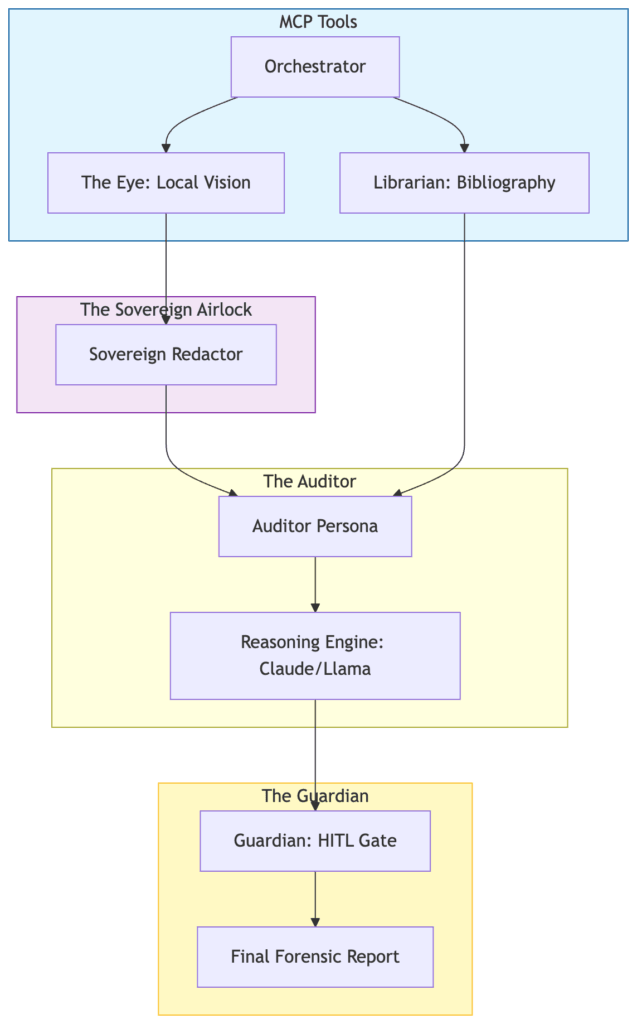
Architectural diagram of the Sovereign Auditor synthesis layer. It shows data flowing from the Librarian (archival data) and The Eye (local vision) into a Reasoning Engine, which then passes through a Guardian HITL gate before generating a final report.
The “Zero-Glue” Synthesis: The Auditor acts as the central nervous system, merging local perception with archival ground-truth while governed by the Guardian handshake.

The Shield is up. The Verdict is in.

We have successfully built the Sovereign Vault. By combining local perception, edge security, and high-reasoning synthesis, we have moved from “prompt-engineered assistants” to a governed Expert System

But beyond the code, what does this mean for the industry? In our next post before we wrap things up, we look at the “Big Picture”: Why the Model Context Protocol is the strategic “USB-C” for the next decade of Enterprise AI.

Coming Next: The Sovereign Vault: Why MCP is the USB-C for Enterprise AI.

Facebooktwitterredditlinkedinmail