Part 8 of the Building the AI Memory Stack series
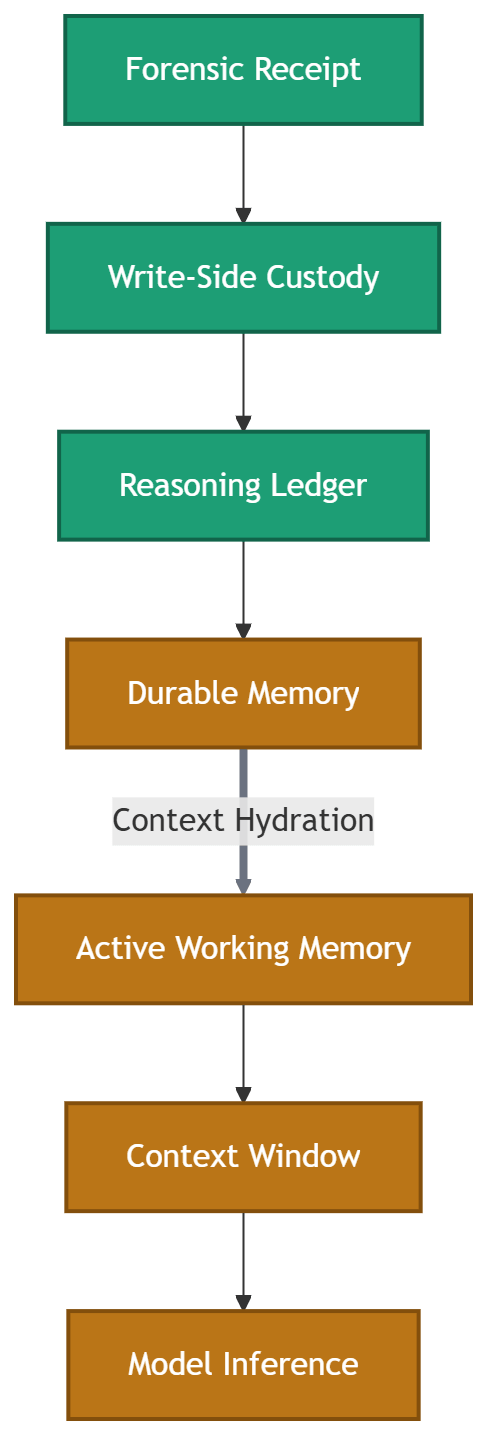
Over the past seven articles we’ve built an architecture that treats memory as infrastructure rather than as an oversized prompt. We’ve separated execution from assembly, preservation from explanation, trust from proof, and finally showed how verified knowledge returns to active reasoning through Context Hydration.
Now it’s time to ask a different question.
What does all of that cost?
Every AI system pays for memory. The only question is where.
Many systems choose to pay almost every cost inside the prompt itself. As context windows grow larger, it becomes tempting to treat them as an infinitely expandable memory system. If the model forgets something, add more documents. If retrieval misses context, increase the top-k value. If the answer is incomplete, make the prompt longer.
That approach works surprisingly well, until it doesn’t.
The cost isn’t limited to API pricing. Large prompts consume attention, increase latency, complicate orchestration, and force the model to separate important information from noise. The result is an architectural bill that grows long before the invoice from your model provider does.
Capacity Is Not Communication
One of the recurring themes throughout this series has been that storage and communication are different problems.
A library may contain every book ever written, but that doesn’t mean every book belongs on your desk while solving today’s problem. Likewise, Durable Memory can preserve years of organizational knowledge without requiring every byte of it to enter today’s Context Window.
The purpose of architecture is deciding what should move, when it should move, and what it costs to move it.
Introducing the Tax Model
The Sovereign Systems Specification describes these recurring costs as architectural taxes. They are not bugs. They are the predictable costs of moving, storing, validating, retrieving, and communicating information through an AI system.
Some taxes are unavoidable.
Others are self-inflicted.
Good architecture minimizes the second category.
The taxes that bear most directly on memory are these.
Prose Tax
Every explanation has a cost.
Humans naturally communicate in paragraphs. Models consume tokens. The more words required to express an idea, the more attention the model must allocate before it can begin reasoning.
High-information-density representations, such as structured records, schemas, identifiers, and references, often communicate the same meaning with a fraction of the prompt budget.
Context Tax
Every additional token competes for attention.
Context windows have grown dramatically, but attention remains finite. As more information enters the prompt, genuinely important information must compete with increasingly irrelevant material.
Bigger windows increase capacity.
They do not guarantee better focus.
Retrieval Tax
Searching for information is not free.
Embedding generation, vector searches, re-ranking, filtering, serialization, and prompt assembly all consume compute and latency before the model has produced a single token of useful work.
As argued earlier in this series, retrieval should support memory, not replace it.
Observer’s Tax
Every measurement has a cost.
Telemetry, debugging information, traces, evaluation artifacts, and compliance records are essential for production systems. Left unchecked, however, they begin competing with operational workloads for compute, storage, and engineering attention.
Observability is infrastructure.
It should not become interference.
Ingestion Tax
The cheapest place to improve information quality is before information enters the system.
Poorly structured data generates downstream costs forever. Duplicate records, inconsistent schemas, missing provenance, and unverifiable observations all create future work for retrieval pipelines, prompt assembly, and reasoning itself.
Every bad write compounds.
Every good write pays dividends.
Fiscal Architecture
Viewed individually, these taxes seem manageable.
Viewed together, they become an architectural discipline.
None of these taxes exist in isolation. Attempts to reduce one often increase another. Expanding a prompt may reduce retrieval work while increasing Context Tax. Adding more telemetry may improve observability while increasing Observer’s Tax. The goal isn’t minimizing a single tax; it’s balancing the entire system.
| Tax | What it charges for | Lowered by |
|---|---|---|
| Prose Tax | Meaning expressed in more tokens than it needs | Structured records over paragraphs |
| Context Tax | Irrelevant tokens competing for finite attention | Hydrating only what the task needs |
| Retrieval Tax | Search, embedding, and re-ranking before any output | Higher memory quality, less searching |
| Observer’s Tax | Telemetry and traces competing with real work | Bounded, purposeful observability |
| Ingestion Tax | Poor structure and missing provenance at the write | Verified, structured writes |
Organizations often spend months optimizing prompts while ignoring the systems that create those prompts. Yet the largest savings usually come from improving memory quality, reducing unnecessary movement, and preserving information in forms that are inexpensive to hydrate later.
Traditional software architecture optimizes CPU, memory, network bandwidth, and storage.
AI architecture adds another economic dimension: attention.
Every architectural decision ultimately affects how much attention the system spends producing useful reasoning.
In other words, the cheapest token is often the one that never needed to exist.
The Goal Isn’t Zero Tax
Every system pays taxes.
A trustworthy system willingly pays some of them.
Hashes must be computed. Receipts must be signed. Memory must be verified before it is restored. Good engineering accepts these costs because they purchase integrity, explainability, and confidence.
The goal is not eliminating cost.
The goal is paying the right costs in the right places.
Looking Ahead
The final article brings everything together.
We’ll revisit the AI Memory Stack from the perspective of runtime execution rather than teaching order, showing how data actually flows through the architecture and mapping each responsibility to the Sovereign SDK. By the end, the stack should feel less like a collection of concepts and more like a blueprint that can be implemented today.