We are currently building AI-native applications inside a linguistic and architectural vacuum.
Over the past year, the industry has thrown billions of dollars at frontier models and cloud orchestration tools while completely neglecting traditional data engineering discipline. We’ve been told that if we simply expand context windows to a million tokens and dump our raw, ambient conversational logs into a managed vector store, the LLM will magically sort it out at runtime.
It doesn’t. Instead, enterprises are hitting massive, systemic walls: attention fragmentation, positional bias (“Lost in the Middle”), data corruption, and skyrocketing API bills.
Recent architectural pivots across the industry—such as multi-agent frameworks shifting away from raw mesh networks to rigid supervisor trees—are symptoms of the exact same underlying disease: we are letting autonomous systems negotiate state through unstructured prose, burning compute without compounding capability.
To break through these walls, we don’t need larger context windows. We need structural boundaries.
Today, I am officially open-sourcing the Sovereign Systems Specification, Glossary, and Pattern Library to establish a rigid, defensive perimeter for local-first AI infrastructure.
Why Patterns Matter: From the Gang of Four to Local Silicon
When the software engineering industry faced the Wild West of early object-oriented development, the “Gang of Four” didn’t invent new languages; they formalized a shared vocabulary in Design Patterns: Elements of Reusable Object-Oriented Software. They gave us names for the invisible structures we were already struggling to build: Singletons, Adapters, Factories. Years later, when the industry shifted from relational tables to document stores, the MongoDB Design Patterns did the same thing for data architecture—formalizing paradigms like the Computed or Outlier patterns so developers could stop guessing how to handle polymorphic, non-relational scaling.
Patterns are essential because the laws of distributed systems do not change just because we throw a neural network in the middle. Right now, AI infrastructure lacks this formalized discipline. Developers are building highly volatile, cloud-dependent “digital attics” because they lack the structural primitives to build load-bearing context pipelines.
The Sovereign Systems Specification bridges this gap, providing repeatable, battle-tested architectural patterns for deterministic, cost-aware, and high-integrity AI inference.
The Sovereign Architecture: Three Pillars of State Control
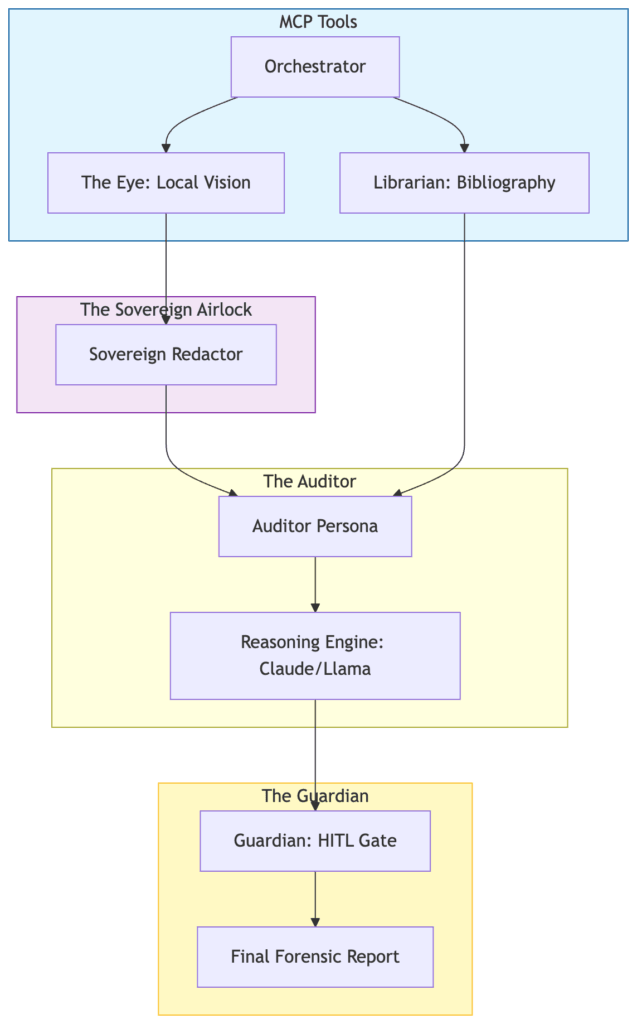
The core thesis of this resource is simple: We must shift from query-time reasoning to strict write-time ingestion boundaries. We treat incoming payloads as untrusted telemetry on local silicon before an external orchestrator ever touches a cloud model.
This open-source release is split into three distinct, load-bearing resources:
- The Sovereign Systems Glossary
A formalized dictionary designed to give engineering teams a shared vocabulary for data flow, risk, and state control. It moves past prompt-engineering “magic spells” and defines rigid terms like: - The Prose Tax & Context Inflation Tax: The geometric compounding of financial cost and model attention decay that occurs when you pass un-optimized, raw text streams across the network.
- Write-Side Custody: The architectural discipline of enforcing structural validation, cryptographic signing, and metadata parsing at the exact point of ingestion before data ever commits to long-term memory.
- The Digital Attic (Anti-Pattern): The chaotic enterprise trap of dumping unvetted, unstructured raw logs into vector storage and assuming semantic search can reliably reconstruct operational context at runtime.
- The Architecture & Execution Framework (
/ARCHITECTURE)
Comprehensive visual blueprints, execution pipeline flows, and runtime orchestration layouts. These documents map the exact physical transition from cloud-dependent, API-mediated routing to localized, edge-native context processing—ensuring data custody and reasoning models remain entirely unified within a secure local boundary. - The Sovereign Inference Pattern Library (
/PATTERNS)
Repeatable, low-level structural primitives for context engineering. It includes detailed layouts for patterns like the Sieve-and-Sign Pattern (aggressively filtering input for semantic noise locally and stamping it with a cryptographic signature) and Pre-Paid Retrieval Precision (paying a fixed token cost upfront to structure context, eliminating the compounding cost of positional bias during runtime queries).
Accessing the Resources
The entire specification index, architectural layouts, and pattern files are open, human-readable, and live today on GitHub Pages:
- Sovereign Systems Specification & Glossary Index
- Architecture & Execution Blueprints
- The Sovereign Inference Pattern Library – In Progress
How to Contribute
This is a living framework built for practitioners who are actively wrestling with these constraints in production. We are explicitly looking for community contributions to expand this shared language:
- Pattern Submissions: Have you engineered a repeatable runtime or filtering primitive that successfully prevents boundary deflection or context inflation? Submit an architectural RFC.
- Case Studies & Anti-Patterns: If your team has successfully migrated away from an ambient context loop or survived a “digital attic” metadata collapse, your post-mortem belongs in this index.
- Documentation Refinements: Help us sharpen definitions, expand the visual data flow blueprints, or map these patterns to specific local Small Language Model (SLM) topologies.
Check out the specification repo, star the project, and open an issue or pull request to get involved:
Sovereign Systems Specification on GitHub
Let’s stop building fragile cloud wrappers. Let’s start engineering sovereign systems.