Sovereign Synapse: The Great Export

For years, we have treated LLMs as a rented brain. We have poured our debugging sessions, research threads, and early project drafts into cloud-hosted chat windows, treating them as convenient extensions of our own thinking.

But, data you do not own is an Infrastructure Tax you cannot afford to pay forever.

This post kicks off a new build thread: Sovereign Synapse. We are initiating a digital evacuation—pulling our intellectual history out of the cloud and into a local, human-readable vault.

Builder’s Note: The Fiscal Architecture of Data
After recent discussions, it’s clear that “Sovereign AI” starts at the ingestion layer. In production, “Privacy” is actually a Financial Strategy. By moving our intellectual assets to local silicon, we eliminate the “Prose Tax”—the expensive tokens wasted on cloud system prompts trying to explain raw, messy data to an agent. We aren’t just saving files; we are building a Sovereign Gateway that ensures every dollar spent on cloud inference is spent on execution, not on interpretation.

The Problem: The Fragmented Self
Your intellectual assets are currently scattered across Claude, ChatGPT, and Gemini. As long as these thoughts live on a corporate server, they are subject to shifting terms of use and “Service Discontinued” notices.

For those using these tools to document a lifetime of expertise, this fragmentation is a risk to Data Provenance. We need a Cognitive Estate that stays on our own silicon, ensuring our reasoning is stored as a Structural Contract, not a digital attic.

The Architecture: The Forensic Ingestor
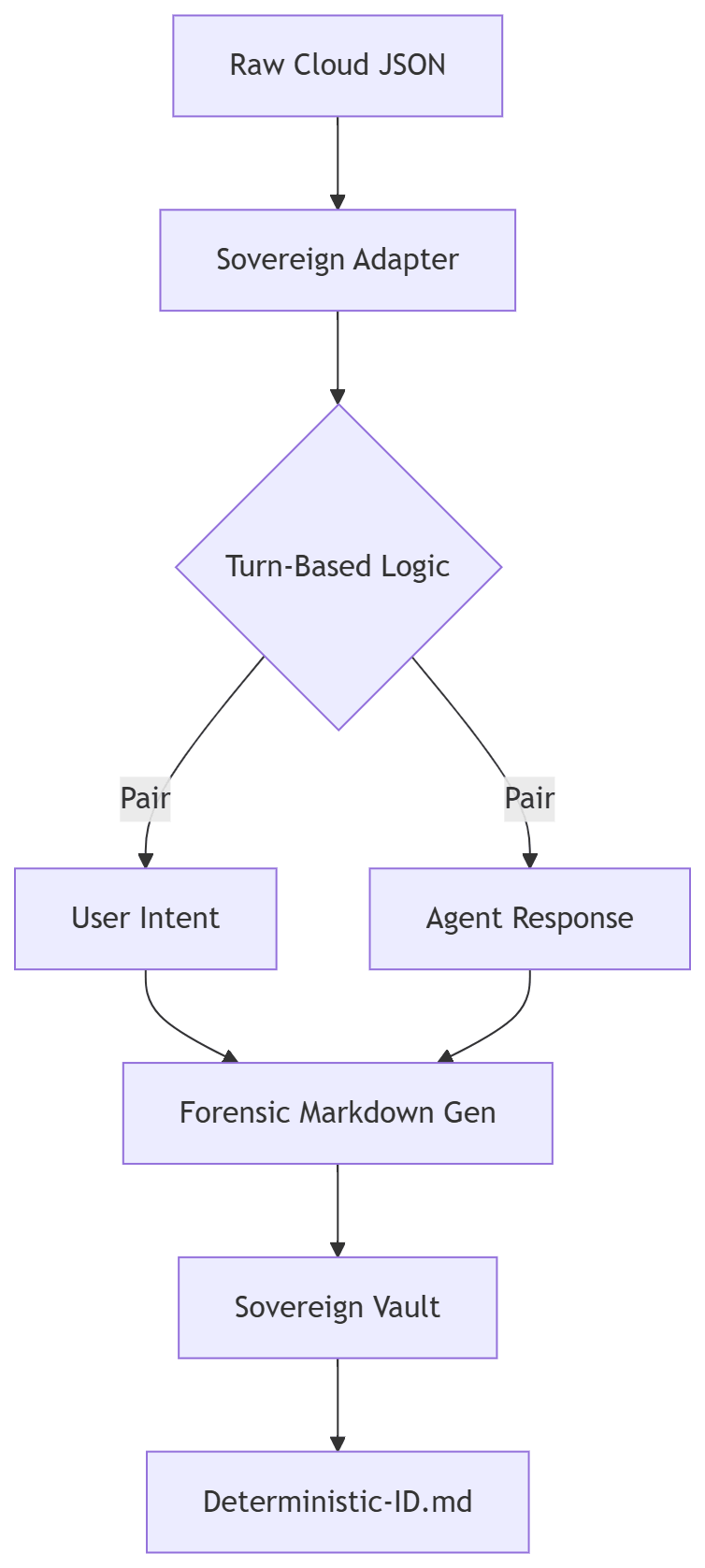
To reclaim this data, we don’t want a disorganized data dump. We want a Synapse. Our first tool is a Forensic Ingestor that transforms raw, nested JSON exports into atomic, “Turn-Based” Markdown files.

The Build: The Sovereign Adapter

We focus on Deterministic ID generation to ensure our Forensic Trace remains unbroken. By hashing the user intent with a timestamp, we create a Forensic Receipt that anchors this memory forever, allowing us to map causal chains across different sessions later.

# adapters/synapse_adapter.py 
import hashlib
import json

def generate_typed_asset(user_text, timestamp, category="Technical/Logic"):
    """
    Transforms a 'Text Blob' into a 'Sovereign Asset.'
    By typing the reasoning during ingestion, we eliminate the 
    'Prose Tax'—the expensive tokens wasted on system prompts 
    trying to explain raw data to an agent.
    """
    # Create a deterministic anchor for the Forensic Trace
    seed = f"{user_text[:100]}-{timestamp}"
    asset_id = hashlib.sha256(seed.encode()).hexdigest()

    return {
        "asset_id": asset_id,
        "type": category,
        "schema_version": "1.0",
        "is_audit_ready": True
    }

# Logic for traversing OpenAI's conversation tree and 
# extracting the "Turn" goes here...

First Light: The Mobility Audit

When I ran this against my own data, the first “Synapse” to appear in my vault was a 2024 conversation about raw data wearables for mobility tracking.

In a medical setting, tracking gait and balance is a critical marker for neurological health. By capturing this conversation locally, I’ve preserved a specific piece of reasoning regarding the Movesense Medical Sensor and MetaMotion R hardware. That conversation is now a Verified Asset. It is no longer a ‘chat history’; it is a queryable part of my own intellectual history—ready for the Sovereign Network.

What is the one conversation in your history that you can’t afford to lose?

The Sovereign Synapse Series

  • The Great Export – This Post
  • The Context Cleaner – Coming 26 May 2026
  • The Local Brain – Coming 2 June 2026
  • The View from the Summit – Coming 9 June 2026
  • The Synapse Navigator – Coming 16 June 2026
  • The Analog Bridge – Coming 23 June 2026
  • The Temporal Mirror – Coming 30 June 2026
  • The Unbroken Voice – Coming 7 July 2026
Facebooktwitterredditlinkedinmail

The Sovereign Redactor — A Precision-Guided Privacy Airlock

In the last post, we gave our forensic system “Eyes” using local Multimodal Vision. We successfully extracted a mysterious handwritten inscription from a first edition of The Great Gatsby without a single pixel leaving our local network.

But perception is only half the battle. To turn that raw text into a forensic verdict, we often need the “High Reasoning” capabilities of frontier cloud models like Claude 3.5 or GPT-4o. This creates a Privacy Paradox: How do we send the context of a finding to the cloud without leaking the Personally Identifiable Information (PII) contained within it?

Today, we implement the Sovereign Redactor—a precision-guided airlock that scrubs sensitive entities at the edge before they hit the egress pipe.

The Problem: NLP Over-redaction

Traditional redaction is a blunt instrument. If you use a simple regex or a basic NER (Named Entity Recognition) model, it might redact the author “F. Scott Fitzgerald” or the publisher “Scribner’s” because it identifies them as PERSON or ORGANIZATION.

In rare book forensics, for example, the author’s name isn’t PII—it’s primary metadata. If we redact the subject of the audit, the cloud-based reasoning agent becomes useless. We need a system that can distinguish between Metadata (to keep) and PII (to hide).

The Stack: Microsoft Presidio + spaCy

To solve this, we integrated Microsoft Presidio. Unlike a standard regex, Presidio allows us to define a complex pipeline of “Recognizers” and “Anonymizers.”

We use spaCy’s en_core_web_lg (Large) model as the underlying NLP engine. This gives the Redactor the linguistic context to understand that “Gatsby” in a book title should stay, but “Gatsby” mentioned as a person’s name in a private letter might need to go.

The Architecture: Secure by Default

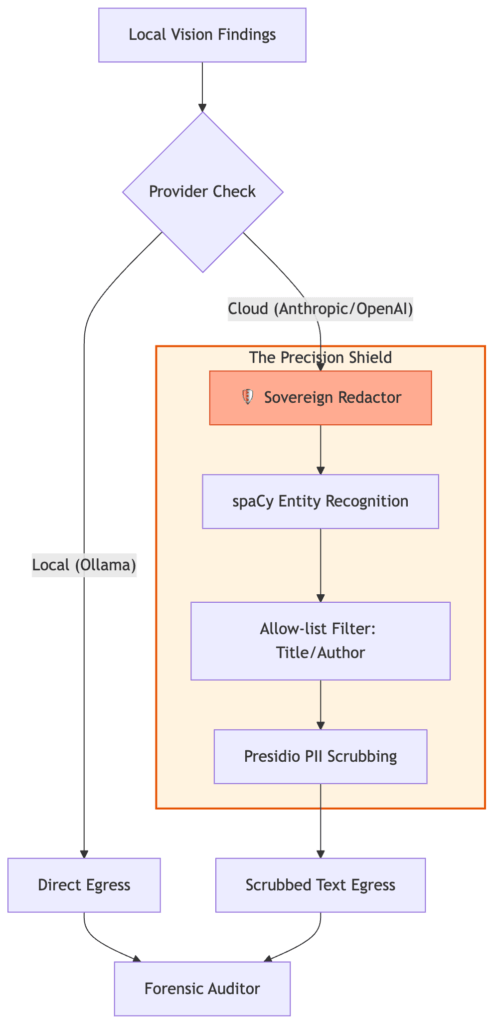
The Redactor is built on a “Secure by Default” philosophy. In our orchestrator, we don’t ask if a provider is “dangerous.” We ask if a provider is Local.

If the provider is ollama or none, the data stays raw. If the provider is anything else (Anthropic, OpenAI, etc.), the Sovereign Vault Airlock engages automatically.

Mermaid diagram showing the Sovereign Redactor airlock architecture. Local vision findings are checked against the provider type; local providers get direct egress while cloud providers pass through a precision shield containing spaCy entity recognition, metadata allow-listing, and Presidio PII scrubbing.
The Precision Shield: How the Sovereign Redactor intercepts sensitive PII at the edge while allowing critical metadata to pass through for cloud-based reasoning.
# The Sovereign Egress Guard
LOCAL_PROVIDERS = {'ollama', 'none'}

if provider not in LOCAL_PROVIDERS:
    # Engage the Airlock
    scrubbed_text, count = redactor.scrub(
        text=visual_findings,
        allow_list=metadata_allow_list
    )
    logger.info(f"🛡️ Sovereign Vault: {count} entities redacted from egress.")

The “Precision Shield”: Using Allow-lists

To prevent the “Fitzgerald” problem, we implement a Precision-Guided Allow-list. Before the Redactor scans the text, the orchestrator dynamically builds a list of “safe” words based on the Master Bibliography:

  1. The Book Title
  2. The Author’s Name
  3. The Publisher’s Name

These entities are passed to the Redactor as an allow_list, instructing Presidio to ignore them even if it’s 99% sure they are PERSON or ORGANIZATION entities.

Resiliency: The “Safe-Fail” Pattern

One of the biggest challenges with local NLP is the resource cost. Loading a 500MB spaCy model into memory is “expensive.”

We implemented a Sentinel-based Lazy Loading pattern. The Redactor only loads when it’s needed. If the system fails to load the model (e.g., missing dependencies), it doesn’t crash the audit. Instead, it marks itself as _REDACTOR_DISABLED, logs a critical warning to the human auditor, and “fails open” to preserve forensic continuity.

“In a forensic system, a hard crash is a loss of data. A safe-fail is a managed risk.”

The Result: Privacy-Preserving Reasoning

When we ran the Gatsby audit, the local Vision Agent found a handwritten note. The Redactor identified three sensitive entities (mentions of a name and a location not in our allow-list) and scrubbed them.

The cloud received this:

“Handwritten note found on title page. Content: ‘I must have you by . I would like to read it for my English class at .'”

Claude 3.5 was still able to reason that the note was non-canonical and unusual for a first edition, without ever knowing the names or locations written in that 100-year-old pencil.

Architect’s Summary

The Sovereign Redactor proves that Privacy and Intelligence are not a zero-sum game. By moving the redaction logic to the edge and using precision allow-lists, we can utilize the world’s most powerful cloud models while ensuring our “Forensic Vault” remains truly sovereign.

Ready to build your own Sovereign Vault?

Explore the hardened SovereignRedactor logic in the mcp-forensic-analyzer repository. Don’t forget to check out the new WALKTHROUGH.md to see how the code evolved from a simple tool to a privacy-preserving airlock.

The Shield is up. Now we need the Verdict.

We have the raw visual data from the Eye. We have the privacy shield from the Redactor. But an audit isn’t a list of findings; it’s a decision.

In our final installment of this series, The Auditor, we introduce the high-reasoning synthesis layer. We’ll explore how to combine disparate forensic streams into a single, structured verdict and implement the Guardian Pattern—a Human-in-the-Loop handshake that ensures the AI never has the final word on a $50,000 asset.

Coming Next: High-Reasoning Synthesis & The Ethics of Autonomous Verdicts.

Facebooktwitterredditlinkedinmail